


Table of contents
Milwaukee PACKOUT Rack System: Built to Keep You Organized On the Go
If you've been in the trades long enough, you know the drill. You spend the first 15 minutes of every job hunting through boxes, bags, and shelves trying to find the right tool or part. Then you waste another 10 minutes at lunch doing the same thing. By the end of the week, you've probably burned through 3-4 hours just looking for stuff that should be right at your fingertips.
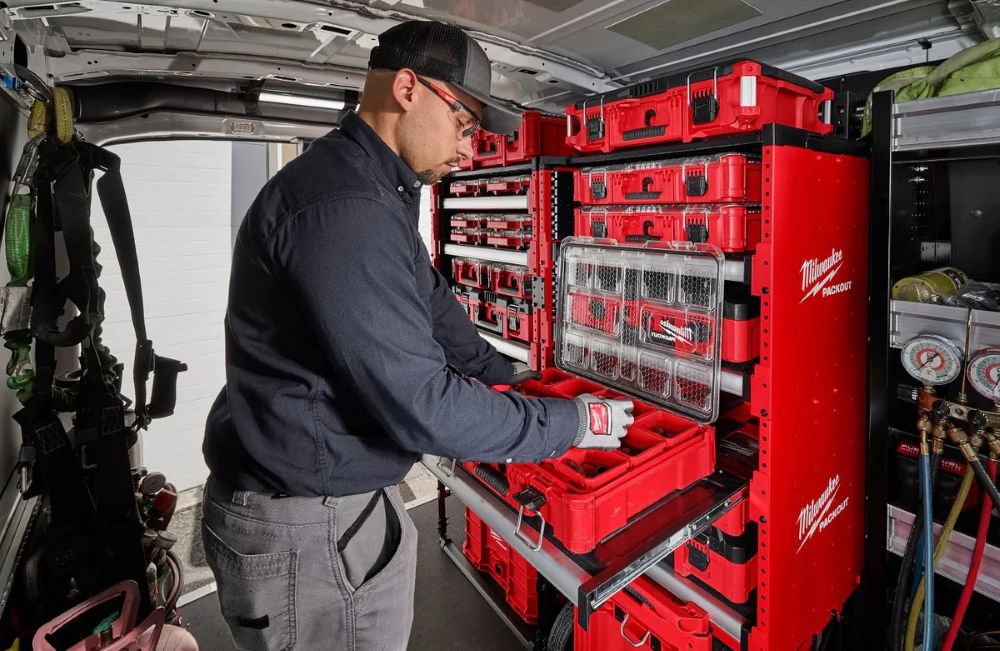
Milwaukee's new PACKOUT Rack system aims to change all that. Instead of piling toolboxes and parts bins on shelves or on the floor, you mount them in sliding drawers on the wall. Each tool box goes in its own drawer, which slides out for quick access. Milwaukee calls this "Ultimate PACKOUT Access," meaning you can reach any toolbox directly with one pull of the drawer. This isn't just another shelving unit – it's a complete rethink of how we organize and access our tools in vans, trucks, shops, and job sites.
What Exactly Is the PACKOUT Rack System?

The PACKOUT Rack system is Milwaukee's answer to the age-old problem of tool organization in mobile work environments. At its core, it's a modular drawer-based storage system that mounts to the walls of work vehicles, shipping containers, shop walls, or trailer interiors.
The system consists of several key components:
PACKOUT Rack : The main unit that holds everything together
PACKOUT Rack Frame : The mounting framework that attaches to your vehicle or wall
PACKOUT Rack Drawer : Individual sliding drawers that hold your PACKOUT boxes and tools
PACKOUT Rack Kit : A complete package that includes multiple racks and drawers
What sets this apart from traditional shelving is that each drawer slides out independently, giving you full access to your Milwaukee packout boxes without having to unstack anything. No more playing Jenga with your tool boxes every time you need something from the bottom.
Technical Specifications: Built for the Real World
The Milwaukee Packout Van Rack system turns your work van into a mobile workshop with heavy-duty modular storage that handles the demands of daily service work.
Built around the proven PACKOUT platform, it secures your tools and equipment during transport while keeping everything organized and accessible on the job site. The system grows with your operation: start with one rack and expand as needed to fit your trade's specific requirements.
Weight Capacity and Durability
Each Milwaukee Packout Rack drawer can support up to 50 pounds while in transit. That's solid capacity for most applications – enough for a fully loaded PACKOUT toolbox plus some extras. The overall system is built to handle the vibration and movement that comes with daily driving to job sites.
The complete rack assembly measures 21 inches long, 22 inches high, and 27.3 inches wide when fully assembled, weighing in at 86 pounds. That's substantial enough to feel rock-solid when mounted, but not so heavy that installation becomes a nightmare.
Dimensions and Compatibility

The system is designed around standard PACKOUT dimensions, which means it works with the full range of PACKOUT Tool Boxes, Organizers, Bags, and even compatible power tools. The drawers measure 21 inches long, 2.75 inches high, and 27 inches wide, with each drawer weighing 18 pounds empty.
One of the smartest design choices is the adjustable drawer height system. You can customize the spacing between drawers to fit different combinations of PACKOUT units – from the slim organizers up to the larger tool boxes.
Stackability and Expansion

The system is designed to grow with your needs. You can stack up to three racks high in mid-roof and high-roof vans, and add additional rack kits to span your entire vehicle wall. This modular approach means you can start with one kit and expand as your business grows or your storage needs change.
Vehicle Compatibility: Where It Works Best

Primary Vehicle Support
Ford Transit : Full compatibility across different roof heights
RAM ProMaster : Designed to work with the ProMaster's unique interior dimensions
Mercedes Sprinter : Compatible with various Sprinter configurations
The system works in mid-roof vans and above, which covers most commercial applications. Low-roof vans don't have enough vertical space to make the most of the system's stackable design.
Beyond Vans: Other Applications
While vans are the primary focus, the Milwaukee Packout Rack system is designed for multiple environments:
Shipping Containers and Conex Boxes: Perfect for job site storage that needs to be secure and organized
Enclosed Trailers: Great for contractors who pull trailers between jobs
Shop and Garage Walls: Any flat, reinforced wall can support the system
Step Vans and Box Trucks : Larger commercial vehicles benefit from the expanded storage capacity
Milwaukee is also working on compatibility with additional vehicle types including GMC and Chevrolet step vans and various box truck configurations.
Installation Requirements and Process
Installing the Milwaukee Packout Rack system requires some planning and preparation, but it's designed to be manageable for most users.
Mounting Requirements
The system needs to be mounted to a flat, reinforced wall surface. In vans, this typically means mounting to the side walls using the vehicle's existing mounting points or adding reinforcement plates. The rack frame is what actually attaches to the wall, and then the individual racks mount to this frame.
Professional vs. DIY Installation
Milwaukee offers both self-install and professional installation options. For fleet managers or contractors who need multiple vehicles outfitted, working with an upfitter (professional installer) can provide a turnkey solution. The vehicle gets delivered with everything installed and ready to work.
For individual contractors or smaller operations, self-installation is definitely possible. Milwaukee provides detailed installation guides and measurement instructions to help ensure proper fitment.
What are the measurements you should know before installing?
Proper measurement is critical for a successful installation. Milwaukee's documentation includes detailed instructions for measuring:
Interior height : Floor to ceiling, accounting for roof curves
Interior length : Front bulkhead to rear doors, minus clearance
Interior width : Side to side, measured at floor level and 12 inches up
Wheel well clearances : Important for determining rack placement
The system requires a minimum three-inch clearance above wheel wells when mounted above them.
Digital Planning Tools
Milwaukee provides a free online Rack Builder tool at milwaukeetool.com/rack-builder for planning your setup. The tool includes preset dimensions for common vehicles and lets you enter custom measurements for unique situations. You can drag and drop rack units and PACKOUT products to visualize your layout before installation.
Performance and Benefits
The Milwaukee Packout Rack system addresses several pain points that trades professionals deal with daily. Beyond the obvious organizational benefits, there are practical advantages that become apparent after extended use.
Job Site Efficiency
When you roll up to a job site, the difference is immediate. Instead of digging through stacked boxes or loose tools, each item has its designated spot. Electricians report being able to grab specific wire nuts or connectors without opening multiple containers. Plumbers can access the exact fitting they need without disturbing other materials. This translates to faster setup times and less frustration during critical work moments.
Reduced Tool Loss and Damage
One unexpected benefit users mention is reduced tool loss. When everything has a specific location, it's immediately obvious when something is missing. Traditional shelving systems often lead to tools getting buried under other items or forgotten in hard-to-reach corners. The drawer system makes it much harder for tools to "disappear."
The secure mounting also means less tool damage during transport. Tools aren't sliding around loose shelves or falling when you take a corner too fast. Each Packout box stays locked in its drawer, protecting both the contents and the boxes themselves.
Inventory Management Benefits

For contractors managing multiple crews or vehicles, the system provides better visibility into tool inventory. Fleet managers report that standardized rack layouts make it easier to ensure each truck has the necessary equipment. When a technician needs to switch vehicles, they can quickly orient themselves because everything is in the same relative position.
The visual organization also helps with restocking and maintenance scheduling. It's much easier to see when consumables are running low or when tools need replacement because everything is clearly visible and accessible.
Professional Appearance
The organized appearance of a properly set up Milwaukee Packout Rack system projects professionalism to customers. When a technician can quickly and efficiently access the right tool or part, it builds confidence in their competence. This matters particularly for service calls where customers are watching the work process.
Adaptability Over Time
Multi-Vehicle Benefits
For contractors who operate multiple vehicles or switch between vans and trucks, the consistent PACKOUT interface provides continuity. Workers don't need to relearn a storage system when they move to a different vehicle. This reduces the learning curve for new employees and temporary workers who might need to use different trucks.
How It Compares to Other Systems

To understand the advantage, let's look at how it differs from traditional vehicle shelving solutions. Many older systems use open shelves or bins. Here's how the Milwaukee Packout Rack stands out:
Access: Traditional racks are open shelving. If you need an item in the back, you often have to remove everything in front of it. The Milwaukee PACKOUT Rack's slide-out drawers avoid that completely. You simply open one drawer to reach its box. Milwaukee calls this a "grab-and-go" style of access. Instead of climbing into the van, you just pull out a drawer to grab a drill.
Customization: Older racks have fixed shelf heights with limited adjustability – each shelf might fit only certain box sizes. With the Milwaukee PACKOUT Rack, you can change drawer heights or add/remove drawers. If you upgrade to a larger tool case, you can slide things around to fit it.
Efficiency: With conventional shelving, tools often live loose or in simple plastic bins, forcing crews to re-pack their kits before each job. Milwaukee's approach keeps tools kitted in PACKOUT boxes that fit the rack, so each job's tools can stay ready in place.
Time Savings: Milwaukee's studies show this difference adds up to about 3+ hours per week saved by avoiding the reloading and searching that open shelves require. They estimate that 3-4 hours a week might be "wasted" on older shelving systems just dealing with clutter.
Security: In an open shelf, items can shift or fall during transit unless strapped in. The PACKOUT drawers have locks and latches to hold things tight, so everything stays in place and tools don't get damaged.
Here's a quick comparison:
Feature |
PACKOUT Rack |
Traditional Van Rack |
Access |
Slide-out drawers for direct access to each box |
Open shelves – often need to move things to reach the back |
Customization |
Adjustable drawer heights and mix of sizes |
Fixed shelf spacing with limited adjustability |
Organization |
Tools kept in PACKOUT cases ready for use |
Tools often loose or in bins requiring re-assembly |
Time |
Approximately 3+ hours/week saved (Milwaukee data) |
Approximately 3-4 hours/week extra work (Milwaukee data) |
Security |
Latching drawers keep tools locked in place |
Tools can shift in transit, require straps or gates |
Custom Setups for Different Trades

One of the biggest benefits of the Milwaukee Packout Rack is its adaptability to specific jobs and teams. Different trades can set up their racks in ways that match their workflow:
Electricians often need many small parts and a mix of hand tools. On an electrician's rack, one drawer could hold an organizer with connectors and wires, another could store testers and strippers, and larger drawers below might hold drills and driver sets. Since each item has a fixed spot, electricians don't waste time hunting for that one missing connector as they already know exactly which drawer to open.
Plumbers use pipes, fittings, and wrenches. One setup might dedicate a shallow drawer to small fittings and seals, another drawer to hand tools, and a deeper bottom drawer to heavy power tools like pipe saws or threaders. If a crew changes from residential to commercial work, they can simply swap out the contents of the drawers.
General Contractors and Maintenance Crews often carry a bit of everything. They could organize one column of the rack for fasteners (nails and screws in organizers), a second for hand and power tools, and a third for safety gear or site-specific materials. Even if multiple people share one van, they might each keep one column of drawers as their "personal toolbox."
HVAC Technicians work with both specialized equipment and common tools, plus a variety of parts and consumables. They might dedicate drawers to refrigerant fittings, electrical components, and diagnostic tools, with deeper drawers for manifold gauges and recovery equipment.
Field Service Technicians who service elevators, industrial equipment, or machinery may have standard "repair kits." They could set up a drawer with spare parts specific to their equipment and another with specialized tools. Over time, each drawer becomes the kit for that service task.
The key idea is that trades can customize the rack for their needs. They fill each drawer with exactly the parts and tools they use most, and they do it once. After that, the rack stays organized, saving the hassle of loading and unloading different materials for each job.
Fleet Management Advantages

For contractors managing multiple vehicles and crews, the Milwaukee Packout Rack system offers several fleet-level benefits:
Standardization
Inventory Management
Professional Appearance
Possible Limitations

While the Milwaukee Packout Rack system offers significant advantages, there are some considerations to keep in mind:
Vehicle Compatibility
Initial Investment
Space and Organization
Installation and Professional Support
Upfitter Network
Self-Installation Support
Looking Forward: System Evolution
Milwaukee's Packout Rack system represents Milwaukee's entry into the vehicle storage market, but it's clearly designed with expansion in mind. The modular nature of the system, combined with the digital planning tools, suggests that Milwaukee is planning for long-term development and enhancement.
The digital rack builder tool, in particular, is positioned for ongoing development. Milwaukee has indicated that additional functionality will be rolled out over time, potentially including more vehicle compatibility, enhanced visualization features, and integration with other Milwaukee systems.
Making the Decision: Is It Right for Your Operation?

The Milwaukee Packout Rack system makes the most sense for contractors and tradespeople who:
Already use or are willing to adopt the PACKOUT ecosystem
Spend significant time organizing and accessing tools in their vehicles
Value efficiency and professional appearance
Have compatible vehicles or are planning vehicle updates
Can justify the investment through time savings and improved productivity
For fleet managers, the system offers additional benefits around standardization, training, and professional appearance that can justify the investment across multiple vehicles.
Final Thoughts
Representing a thoughtful approach to mobile tool storage that addresses real problems working contractors face every day. By focusing on accessibility, organization, and integration with the existing PACKOUT ecosystem, Milwaukee has created a system that can improve daily efficiency in measurable ways.
The key to success with any organizational system is adoption and consistent use. The PACKOUT Rack system's design makes it easier to maintain organization over time, which is often where other systems fail. When everything has a designated place and that place is easily accessible, it's much more likely that tools and parts will actually end up where they belong.
Whether you're a one-person operation looking to get more organized or a fleet manager trying to standardize and improve efficiency across multiple crews, the PACKOUT Rack system offers a level of flexibility and functionality that's hard to find in traditional vehicle storage solutions.
Frequently Asked Questions
How much weight can each drawer handle?
Each drawer supports up to 50 pounds while in transit. That's enough for a fully loaded PACKOUT toolbox plus extras.
What do I need to measure before installing the Milwaukee Packout Van Racks?
You'll need interior height (floor to ceiling), length (front to rear doors), width (side to side), and wheel well clearances. Milwaukee's free online Rack Builder tool helps with planning and measurements.
Can I expand the Milwaukee Packout Van Rack system later?
Yes, it's modular. You can stack up to three racks high in mid-roof and high-roof vans and add additional rack kits to span your entire vehicle wall. Start with one kit and expand as needed
Can multiple crew members share one van's rack system?
Yes, each person can have their own column of drawers as a personal toolbox, or drawers can be organized by function rather than by individual.
What are the exact dimensions of the Milwaukee Packout rack kit?
The complete Milwaukee PACKOUT Rack Kit (48-21-8070) measures 63 inches high, 27.3 inches wide, and 21 inches deep. This gives you a full-height storage solution that maximizes vertical space in mid-roof and high-roof vans.
Can I mount multiple systems side by side?
Yes, at 27.3 inches wide each, you can fit multiple systems across a van wall. A typical van might accommodate 2-3 systems, depending on doors, windows, and other equipment.


