


Table of contents
The Milwaukee 5150-20 M18 FUEL Branch Conduit Bender represents a fundamental shift in how electricians handle conduit bending. This industry-first portable cordless conduit bender eliminates the physical strain and setup hassles of traditional hydraulic benders while delivering unprecedented accuracy through AUTO-ZERO technology.
For commercial and industrial electricians working on branch installations, this bender completely changes the workflow. Instead of measuring, marking, hauling conduit to a stationary bender, and hoping your measurements account for bending springback, you can bend conduit exactly where you need it with automatic zero-degree sensing on every bend.
Understanding the Conduit Bending Challenge
Conduit bending has challenged electricians since the trade began. Hand benders require significant physical effort, especially on larger conduit sizes. A 90-degree bend in 1-inch EMT takes substantial force and technique. Multiply that by dozens or hundreds of bends per job, and you're looking at serious physical strain.
Hydraulic benders remove the physical effort but create their own problems. These stationary tools live in the shop or on trailers. You measure at the installation point, return to the bender, make the bend, and carry the conduit back to check fit. Mistakes mean repeating the entire process. The back-and-forth wastes time and guarantees you'll hit your daily step count.

The accuracy problem compounds the efficiency problem. Traditional benders, both hand and hydraulic, start each bend from wherever you place the conduit. Slight variations in starting position translate to variations in bend angles. Even experienced electricians deal with springback that varies based on conduit brand, temperature, and the phase of the moon (or so it seems).
These challenges drove Milwaukee to develop the 5150-20. The goal was to eliminate the physical strain while improving accuracy beyond what even skilled electricians achieve with traditional equipment.
AUTO-ZERO Technology Explained

AUTO-ZERO technology represents the biggest innovation in conduit bending in decades. Here's how it works: built-in sensors detect the conduit's actual starting position before every bend. The tool automatically accounts for any variation and adjusts its stopping point to deliver the exact angle you programmed.
Traditional benders assume perfect starting position. If the conduit sits slightly off zero, your 90-degree bend comes out at 88 or 92 degrees. With AUTO-ZERO, the bender senses whether you're starting at 0, 2, or 5 degrees and compensates automatically. Your programmed angle is what you get, every single time.
According to Milwaukee, this technology delivers unrivaled bend accuracy from pipe to pipe and over the tool's life. The system doesn't drift or require periodic recalibration. It senses zero on every bend, so the first bend of the day matches the hundredth bend of the week.
This consistency matters tremendously for multi-bend runs. When you're making offset bends, saddles, or complex routing, having each individual bend hit its exact target means the overall run comes out right. Traditional methods accumulate errors across multiple bends. AUTO-ZERO eliminates error accumulation.
Capacity and Application Range

The Milwaukee 5150-20 handles EMT (electrical metallic tubing) up to 1 inch and rigid metallic conduit (RMC) up to 3/4 inch. This covers the overwhelming majority of branch circuit installations in commercial and industrial buildings.
Branch circuit work differs from service entrance or feeder conduit. Branch circuits distribute power from panels to individual loads like outlets, lighting, and equipment. These typically use 1/2 inch, 3/4 inch, or 1 inch conduit. Larger sizes require different bending equipment and techniques.
The tool ships with two bending shoes: one for 3/4 inch EMT / 1/2 inch RMC and another for 1 inch EMT / 3/4 inch RMC. Additional shoes for 1/2 inch EMT are available separately. The shoes install and remove tool-free, letting you switch sizes quickly as job requirements change.
This capacity range targets the sweet spot of electrical installations. Residential and light commercial work runs mostly 1/2 inch and 3/4 inch EMT. Industrial and heavy commercial includes more 3/4 inch and 1 inch. The 5150-20 covers all these applications in a single portable tool.
Performance and Power
The POWERSTATE brushless motor provides the muscle to bend conduit without plugging into wall power or running hydraulic pumps. Brushless motors deliver more torque than brush motors while running cooler and lasting longer. The electronic commutation eliminates the friction and wear of mechanical brush contact.
REDLINK PLUS intelligence manages power delivery from battery to motor. The system monitors current draw, temperature, and battery state continuously. If you're pushing the tool beyond safe limits, it automatically reduces power to protect the motor and battery. You get maximum performance without risking tool damage.
M18 REDLITHIUM XC5.0 batteries provide the runtime electricians need. Milwaukee rates the bender at up to 110 bends on 3/4 inch EMT conduit per charge. Real-world runtime varies based on bend angles and conduit condition, but you'll get a full morning or afternoon of bending from a single battery.
The power delivery stays consistent throughout the battery discharge. Traditional cordless tools slow down as the battery drains. The 5150-20 maintains constant bending speed from full charge down to the point where the battery protection kicks in. Your last bend of the charge takes the same time as your first bend.
Ergonomics and Physical Benefits

The Milwaukee 5150-20 reduces peak muscle effort in the lower back by 10 times compared to hand bending. Let that sink in. Not 10 percent reduction. Ten times reduction. If hand bending a 90-degree elbow required 100 units of force through your back, the power bender requires 10 units.
This matters enormously for career longevity. Lower back problems plague electricians who spend years hand bending conduit. The repetitive strain accumulates over thousands of bends. Reducing that strain by 90% means electricians can work full careers without the chronic back pain that forces many out of the trade.
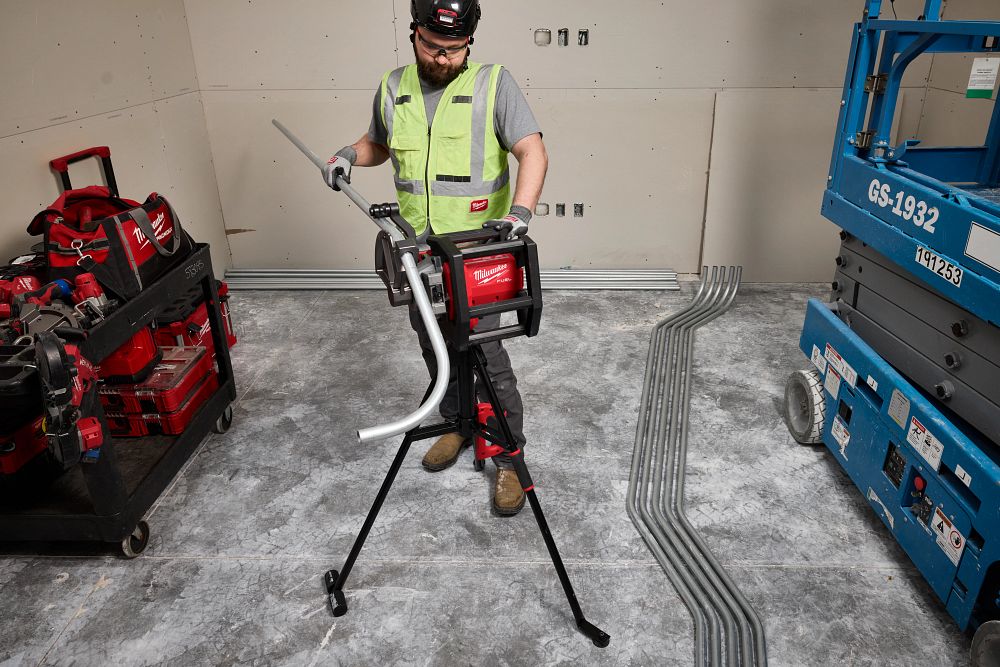
The optimal working height keeps you in comfortable positions throughout the bending process. The shoe and backformer orientation positions critical layout points at eye level. You don't crouch, stoop, or crane your neck to align marks and verify angles. Everything you need to see is naturally visible from a standing position.
The tripod provides stable support during bending. Unlike traditional benders that require you to hold and stabilize conduit throughout the bend, the tripod locks the conduit in place. You press a button and watch the bend happen without wrestling the conduit or straining to maintain position.
Speed and Efficiency Gains
The Milwaukee 5150-20 delivers what the company calls the fastest bends from start to finish. This speed comes from multiple factors working together.
First, you're bending at the installation point. No more measuring, walking to a remote bender, making the bend, and carrying conduit back. You work right where the conduit will install. This eliminates the back-and-forth that eats huge amounts of time on traditional workflows.
Second, AUTO-ZERO eliminates correction bends. Traditional bending often requires test bends, measuring the result, adjusting technique, and trying again. With AUTO-ZERO, you enter the angle, press the button, and the bend comes out right. No test bends, no corrections, no wasted conduit.
Third, the consistent accuracy lets you pre-bend multiple pieces with confidence. When you need several identical bends, traditional methods require careful attention to technique on each piece. With AUTO-ZERO, you set the angle once and bend piece after piece knowing they'll all match exactly.
The time savings compound across a day. Five minutes saved per bend adds up to significant time over a project. That time translates directly to labor cost savings for contractors and faster project completion.
Accuracy Benefits

Bend accuracy affects more than just how tight joints fit together. Accurate bending reduces the fiddling and adjusting that wastes time during installation. When every bend hits its mark, conduit runs align properly with boxes, panels, and fixtures without forcing or modifying.
The springback compensation built into AUTO-ZERO technology accounts for the elastic recovery that conduit exhibits after bending. All metal springs back slightly after forming. The amount varies based on conduit wall thickness, material properties, and bend radius. AUTO-ZERO measures the actual starting point and calculates the stopping point that delivers the target angle after springback.
This eliminates the experience-based adjustments that electricians learn through trial and error. Experienced benders know to overbend slightly to account for springback. But "slightly" varies by conduit type and bending conditions. AUTO-ZERO removes the guesswork and delivers consistent results regardless of those variables.
For complex bends like offsets and saddles, the improved accuracy of each individual bend means the overall assembly comes together correctly. Offset bends require matching angles that add up to parallel conduit sections. If your bends vary by even a few degrees, the offsets won't align properly. Consistent accuracy on each bend ensures the finished offset matches the blueprint.
Complete System Components
The Milwaukee 5150-20 ships as a complete bending system with everything needed to start working immediately except batteries and charger.
The tool includes two bending shoes covering the most common conduit sizes. The 3/4 inch EMT / 1/2 inch RMC shoe handles medium-sized branch circuits. The 1 inch EMT / 3/4 inch RMC shoe tackles heavier branch work. These shoes install and remove without tools for quick size changes.

The sturdy tripod provides stable support during bending operations. Three legs distribute weight evenly and prevent tipping during the bending cycle. The tripod folds for transport and storage. Setup takes seconds, letting you move between bending locations quickly.
The backformer applies counterpressure during bending to maintain conduit shape and position. Quality bends require proper support at the bend point. The backformer ensures consistent results by keeping the conduit properly aligned throughout the bending process.
Replacement shoes are available separately for different sizes and conduit types. If you primarily work with 1/2 inch EMT, order the dedicated 1/2 inch shoe for optimized performance. The modular shoe system lets you customize the tool for your specific needs.
Battery Requirements and Runtime
The Milwaukee 5150-20 operates on M18 REDLITHIUM batteries, the same platform powering over 200 Milwaukee cordless tools. If you already own M18 tools, your existing batteries work with the conduit bender. This compatibility reduces total cost and simplifies battery management.
Milwaukee recommends XC5.0 or larger batteries for optimal performance. Smaller compact batteries don't provide adequate current for sustained bending operations. The high current draw during bending cycles requires batteries designed for high-drain applications.
HIGH OUTPUT batteries provide even better performance. The M18 HIGH OUTPUT HD12.0 battery delivers maximum runtime and maintains power throughout extended bending sessions. For all-day bending jobs, start with fully charged HIGH OUTPUT batteries.
Runtime varies based on several factors. Conduit size affects power requirements. Larger conduit requires more force to bend. Bend angles matter too. Ninety-degree bends consume more battery than thirty-degree bends. Conduit condition plays a role. Scratched or corroded conduit requires more force than clean new material.
Under typical conditions bending 3/4 inch EMT to 90 degrees, expect 90-110 bends per XC5.0 battery charge. That's enough for most morning or afternoon sessions. Keep spare batteries charged and swap between bending cycles to maintain productivity all day.
Programming and Operation
Operating the Milwaukee 5150-20 is straightforward once you understand the basic workflow. The learning curve is much shorter than mastering hand bending techniques.
The control panel lets you program bend angles in one-degree increments. Need a 32-degree bend for an offset? Enter 32 degrees. Want a 90-degree stub-up? Enter 90 degrees. The digital interface removes the geometry calculations traditional bending requires.
After programming the angle, position the conduit in the shoe according to your layout marks. The optimal working height means you can see the reference marks clearly without awkward positioning. Align your mark with the shoe's reference point, secure the conduit, and you're ready to bend.
Press the trigger to begin the bending cycle. AUTO-ZERO technology senses the starting position automatically. You don't manually zero the tool. It handles that automatically on every bend. The motor drives the bend smoothly to the programmed angle and stops precisely when the target angle is reached.
The bent conduit comes out of the shoe ready to install. No post-bend measuring or angle verification needed. If you entered 32 degrees, you got a 32-degree bend accounting for springback. The accuracy lets you focus on layout and installation rather than verification and correction.
Applications and Use Cases

Branch circuit installations consume most of the Milwaukee 5150-20's working hours. These circuits run from distribution panels to individual loads throughout buildings. Typical commercial installations include hundreds or thousands of linear feet of branch conduit.
The portable nature shines in occupied spaces where hauling conduit back to shop benders isn't practical. Tenant improvements, renovations, and retrofit work benefit enormously. Bend conduit in place without disrupting building operations or blocking corridors with long sections of unbent conduit.
Industrial installations often require conduit routing through complex mechanical spaces. Steel structures, existing equipment, and tight clearances make every installation unique. Bending at the installation point lets you verify fit and adjust routing on the fly. Changes that would require multiple shop trips with traditional bending happen immediately on site.
Service and maintenance work frequently requires replacement conduit runs. The Milwaukee 5150-20 travels easily to service calls. No trailer-mounted bender needed. Throw the bender and a couple batteries in the truck and handle any service call requiring new conduit runs.
Multi-level commercial buildings present specific challenges. Carrying pre-bent conduit up stairs or through elevators risks damage and takes time. With the 5150-20, bring straight conduit sticks to the work floor and bend as needed. This works especially well in high-rise construction where material handling becomes a major logistics challenge.
Integration with Existing Tools and Workflows
The M18 battery platform compatibility is a huge advantage for electricians already invested in Milwaukee cordless tools. The 5150-20 uses the same batteries as M18 drills, impacts, bandsaws, and other common electrical tools. You're not buying into a separate battery ecosystem with unique chargers and incompatible packs.
Battery sharing improves utilization across your tool fleet. When you're not bending conduit, those batteries power your other tools. When bending work ramps up, you can dedicate more batteries to the bender. The flexibility optimizes battery usage across varying workloads.
The tool's footprint integrates easily into service trucks and job boxes. It's not a massive piece of equipment requiring dedicated storage. The folding tripod reduces storage size. Shoes store separately, taking minimal space. Everything fits in a standard gang box or truck compartment.
For contractors running multiple crews, the 5150-20 provides consistency across teams. Every electrician using AUTO-ZERO technology produces identical bends. This uniformity improves installation quality and reduces callbacks for poorly fitting conduit runs. Training time decreases because the tool handles the technique-sensitive aspects of bending.
Comparison to Traditional Bending Methods
Hand bending remains the baseline that all other methods improve upon. For decades, electricians learned to "know their bender" - understanding exactly how far to pull for each bend angle, compensating for springback through experience, and developing the feel that separates journeymen from apprentices.
The Milwaukee 5150-20 eliminates the experience curve. An apprentice using AUTO-ZERO technology produces bends as accurate as a master electrician with hand benders. The tool provides the precision and consistency that took years to develop manually. This democratization of bending skill improves overall installation quality.
Stationary hydraulic benders provide power and consistency but lack portability. Their accuracy depends on proper setup and consistent technique. They eliminate physical strain but introduce workflow inefficiencies through the measure-return-bend-check-install cycle. The 5150-20 captures the power and consistency while adding portability.
Battery-powered hydraulic benders attempted to bridge the portability gap but added weight and complexity. Hydraulic systems require maintenance, leak prevention, and careful handling. Electronic control of the 5150-20 removes hydraulic complications while delivering equivalent or better performance.
Overall
The Milwaukee 5150-20 M18 FUEL Branch Conduit Bender with AUTO-ZERO represents genuine innovation in electrical installation tools. By combining cordless portability, powered bending, and automatic zero-sensing technology, Milwaukee created a tool that fundamentally improves the conduit bending workflow.
The accuracy benefits alone justify the tool for many contractors. Consistent bends reduce rework, improve installation quality, and decrease material waste. AUTO-ZERO eliminates the variability inherent in traditional bending methods.
The ergonomic advantages matter tremendously for career longevity. Reducing lower back strain by ten times compared to hand bending protects electricians from cumulative injuries that plague the trade. Tools that keep electricians working full careers deliver value far beyond their purchase price.
The time savings compound across projects. Bending at the installation point eliminates the back-and-forth that wastes hours on traditional workflows. Consistent accuracy reduces test bends and corrections. The cumulative time savings translate directly to labor cost reductions.
M18 platform compatibility leverages existing battery investments and simplifies tool management. Contractors already committed to M18 tools add the 5150-20 without buying into a separate battery ecosystem. Battery sharing optimizes utilization across varying workloads.
For electricians doing significant branch conduit work, the Milwaukee 5150-20 transforms one of the most physically demanding and time-consuming aspects of installations. The combination of portability, power, and precision makes this tool a genuine advancement rather than just an incremental improvement over existing methods.
Frequently Asked Questions
Does the Milwaukee 5150-20 work with non-Milwaukee batteries?
No. The tool requires genuine Milwaukee M18 batteries. Third-party batteries may physically fit but lack the communication protocols and power delivery characteristics Milwaukee's system requires. Using unauthorized batteries voids warranties and risks tool damage.
Can I bend stainless steel conduit with the 5150-20?
The tool is designed for standard EMT and RMC conduit. Stainless steel conduit has different material properties requiring different bending forces. Check with Milwaukee technical support before attempting alternative materials to avoid tool damage.
How accurate is AUTO-ZERO compared to hand bending?
AUTO-ZERO delivers bend accuracy within one degree of the programmed angle. Skilled hand bending typically achieves accuracy within 2-3 degrees. The automated system provides approximately 2-3x better consistency than expert hand bending.
How long does a battery charge take?
Standard M18 chargers fully charge an XC5.0 battery in approximately 60 minutes. Rapid chargers reduce this to 30-40 minutes. HIGH OUTPUT HD12.0 batteries require longer charging times proportional to their higher capacity.
Does AUTO-ZERO need calibration?
No. AUTO-ZERO automatically senses zero on every bend. The system doesn't drift or require periodic calibration. This self-calibrating design eliminates maintenance requirements and ensures consistent accuracy throughout the tool's life.