


Table of contents
Summer is one of the busiest times of the year for HVAC/R technicians. The schedule fills up fast. You're out early, running from one service call to the next, and every tool needs to have a purpose.
The wrong tool can slow you down. A clamp meter that isn't designed for HVAC/R work may struggle with variable-speed equipment. A corded vacuum pump means looking for power on rooftops, in attics, or anywhere outlets are hard to reach. An inspection camera with a short cable can make it difficult to see deep enough into an air handler or drain line to find the problem.
Milwaukee's HVAC/R lineup was built with those everyday challenges in mind. These tools are designed around the work HVAC/R technicians do every day, from electrical troubleshooting and temperature measurement to evacuations, inspections, and system diagnostics.
The lineup includes clamp meters and fork meters for electrical testing, contact and infrared temperature tools, a cordless vacuum pump for rooftop and attic work, and inspection cameras that help with ductwork, drain line, and equipment inspections throughout the busy summer season.
The Right Meter Makes All the Difference
Not every clamp meter works well for HVAC. Standard electrical meters are accurate for general wiring work, but HVAC/R systems run variable-speed compressors, ECM motors, and inverter-driven equipment that can throw off a basic meter. You need True-RMS accuracy to get a reliable reading on that kind of load.
Milwaukee's HVAC/R meters are built with those conditions in mind. You're getting accurate readings, a jaw profile that fits in tight equipment spaces, and a display that's actually readable in a dark mechanical room or a bright rooftop in July.
HVAC/R Clamp Meters

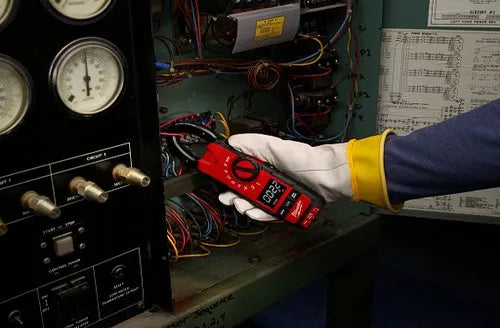
The Milwaukee 2236-20 Clamp Meter is designed specifically for HVAC/R work. It's True-RMS, which gives you accurate readings on variable-speed compressors and ECM motor loads that would throw off a basic averaging meter.
The jaw profile is built to fit in tight equipment spaces. The white-on-black display reads clearly in low-light conditions, which matters when you're in a mechanical room or crawlspace.
If you work in markets where calibration documentation is required by a customer or account, the 2236-20NST is the same meter with a NIST calibration certificate included. Some commercial and industrial accounts need that documentation before they'll let you on site.
Fork Meters for HVAC/R

The fork meter is a different tool with a specific use case. Instead of clamping around a single conductor, the open-fork tip slips over a wire without requiring you to separate it from the bundle. That makes it faster for quick current checks at a contactor or capacitors.
The 2206-20 is Milwaukee's HVAC/R fork meter. It's built for the kind of field checks you're running throughout the day when you need a current reading without fully opening up the wiring.
The 2206-20NST is the same meter with NIST calibration documentation. Same tool, same field performance, with a certificate if your work requires it.
| Model | Type | NIST | Key Features |
| 2236-20 | ClampMeter | No |
True-RMS, thin jaw, white-on-black display |
|
2236-20NST |
ClampMeter |
Yes |
Same as 2236-20 with NIST calibration certificate |
| 2206-20 | ForkMeter |
No |
Open-fork tip, no wire separation needed, HVAC/R rated |
|
2206-20NST |
ForkMeter | Yes |
Same as 2206-20 with NIST calibration cer |
Temperature Measurement on the Job
Temperature is one of the most important measurements you'll take on an HVAC call. Subcooling, superheat, supply and return air differentials, heat exchanger surface temps, and line temperatures all tell you what's happening inside a system.
You might be wondering: do I need both a contact thermometer and an infrared gun? In most cases, yes. Each one gives you different information. Contact measurement gives you accurate readings on surfaces where emissivity would throw off infrared. Infrared lets you scan from a distance without touching the surface. Having both means you're not working around the limitations of one tool all day.
Contact Temperature Meter

The Milwaukee 2270-20 is a contact temperature meter that measures surface and pipe temperatures via probe. You're attaching directly to the line or surface, which gives you reliable readings on shiny copper pipe, polished aluminum fins, and refrigerant lines where an infrared gun wouldn't be accurate.
Contact measurement is the right method when you need an accurate superheat or subcooling reading and the surface material would cause an IR gun to give you a bad number.
The 2270-20NST is the NIST-calibrated version. It functions the same way in the field, with a calibration certificate included for accounts that require it.
Non-Contact Infrared Temperature Measurement

The 2225-20 Non-Contact Voltage Detector and IR Thermometer gives you two functions in one tool. The infrared side measures from -22F to 482F, which covers the range you'd encounter on most residential and light commercial HVAC work.
The 10:1 distance-to-spot ratio means you need to be reasonably close to the surface for an accurate reading. It's a grab-and-go tool for quick surface checks on supply vents, ductwork, and equipment panels.
Here's the deal: for quick surface scans during an HVAC call, the IR thermometer side of the 2225-20 handles most of what you need without adding another dedicated tool to your bag.
| Model | Type | NIST | Temp Range |
| 2270-20 |
Contact Probe |
No |
Per probe spec |
|
2270-20NST |
Contact Probe |
Yes |
Per probe spec |
| 2225-20 |
IR + Voltage Detector |
No |
-22F to 482F |
Non-Contact Voltage Detection for HVAC
Before you touch anything in a control panel or disconnect, you need to verify the power is actually off. Non-contact voltage detection is a basic step that a lot of techs do with a separate tester they're carrying anyway.
The Milwaukee 2225-20 combines a non-contact voltage detector with a laser infrared thermometer in a single unit. It detects voltage from 12V to 1000V AC and is rated CAT IV 1000V for the most demanding electrical environments.
The infrared thermometer side measures from -22F to 482F. It's not a long-distance spot-ratio tool, but it gives you a quick surface temperature check on the same device you're already holding to test voltage.
For a tech who's already carrying a clamp meter and a contact probe, the 2225-20 earns its spot in the bag because it handles two useful checks in one unit without taking up much room.
The Vacuum Pump That Cut the Cord

If you've been hauling a corded vacuum pump to every job, you already know the issues that come with it. The cord is never long enough for rooftop installs. Finding an outlet in an attic means running an extension cord from a living space. On residential calls, that sometimes means asking the homeowner for access inside their house just to pull a system down.
"Current corded solutions disrupt residential and light commercial HVAC Technicians’ workflow sending them searching for power sources, potentially inconveniencing a customer by seeking power inside their home. The introduction of our M18 FUEL 5 CFM Vacuum Pump eliminates the hassles of hunting for outlets, operating generators, or running long extension cords." – Alec Dietzel, Product Manager at Milwaukee Tool
The Milwaukee 2941-21 M18 FUEL 5 CFM Vacuum Pump runs on the M18 REDLITHIUM battery platform. No cord. No outlet required. It pulls at 5 CFM, which covers residential and most light commercial refrigeration systems.
The POWERSTATE Brushless Motor delivers corded-level pull-down performance from a battery. You're not giving up evacuation speed to go cordless. It pulls down at the same rate you'd expect from a comparable corded unit.
Manifold mode is worth understanding. Once the system reaches your target vacuum level, you can switch into manifold mode, which reduces the pump's power draw and extends runtime up to 90 minutes. That covers the soak period without burning through battery charge.
The pump has three service ports: 1/2 inch, 3/8 inch, and 1/4 inch. That covers standard manifold connections for most residential and light commercial systems without needing adapters.
REDLINK PLUS Intelligence monitors operating conditions and protects against overload. On a hot rooftop in July with ambient temps pushing past 100 degrees, that protection matters.
The 2941-21 kit includes the pump and an M18 REDLITHIUM battery. If you're already running M18 tools, the battery you use for other equipment works here too.
| Spec | Detail |
| Model | 2941-21 |
|
CFM Rating |
5 CFM |
|
Motor Type |
POWERSTATE Brushless |
|
Battery Platform |
M18 REDLITHIUM |
|
Service Ports |
1/2", 3/8", 1/4" |
|
Manifold Mode Runtime |
Up to 90 minutes |
|
Intelligence |
REDLINK PLUS overload protection |
Inspection Cameras for HVAC Work
A lot of HVAC diagnosis comes down to seeing what you can't check with your eyes from the access panel. Coil condition inside an air handler, ductwork issues behind drywall, blocked or cracked drain lines, heat exchanger cracks on a furnace call in the fall - these require a camera to actually confirm what's happening.
Milwaukee's M12 M-Spector 360 cameras run on M12 batteries and are built for confined space inspection work. The 360-degree image rotation feature is designed specifically for situations where the camera head is oriented sideways or inverted, and you need to read the image right-side up without repositioning the cable.
4-Foot Cable: Milwaukee 2323-21

The 2323-21 has a 4-foot cable with a 10mm camera head and a 4.3-inch LCD display. It's the right tool for shorter-reach jobs: checking inside an air handler cabinet, inspecting a drain pan for algae or standing water, or looking at coil condition close to the access panel.
The 360-degree image rotation lets you read the display clearly regardless of which way the camera head is oriented in the duct or cabinet. That's a practical feature when you're working in a tight space and can't control the cable angle.
10-Foot Cable: Milwaukee 2324-21

The 2324-21 steps up to a 10-foot cable and 720p resolution. The extra reach handles deeper ductwork inspection, horizontal drain line checks where you need to follow the line a few feet in, and situations where the access panel isn't close to the area you need to see.
The 720p resolution and SD card storage let you capture images or video for documentation. That's useful on commercial calls where you're leaving a service report or showing a facility manager what you found.
Both cameras run on M12 batteries. If you're already using M12 tools on residential and commercial calls, you're set. The 4-foot model handles most routine inspection work. The 10-foot model is for the jobs where you need more reach and better documentation.
| Model | Cable Length | Resolution | Display | Best For |
| 2323-21 | 4ft | Standard |
4.3" LCD |
Air handlers, cabinets, drain pans |
| 2324-21 | 10ft |
720p HD |
4.3" LCD + SD |
Deep ductwork, drain lines, long |
Which Tools Should Be in Your Bag?
The answer depends on the work you do most. Here's a practical breakdown for different types of service technicians.
If you're doing mostly residential service and maintenance, the core kit covers these tools:
- 2236-20 or 2236-20NST clamp meter for electrical measurement
- 2270-20 contact temp meter for subcooling and superheat readings
- 2225-20 for non-contact voltage detection and quick IR temp checks
- 2941-21 M18 FUEL vacuum pump for all evacuation work
- 2323-21 inspection camera for air handler and drain pan checks
If you're on the commercial side or regularly working on larger systems, the 2206-20 fork meter is a useful addition for quick current checks at contactors and capacitors. The 2324-21 10-foot inspection camera handles deeper drain line and ductwork inspections where the 4-foot cable won't reach.
If your accounts require calibration documentation, swap in the NIST versions of the clamp meter and contact temp meter. The 2236-20NST and 2270-20NST carry the certificates that some commercial and industrial customers need before you can start work.
For fork meter users, the 2206-20NST covers the same documentation requirement. It's the same fork meter with NIST calibration included.
All The HVAC Tools You Need
Summer service calls keep coming, and the tools in your bag need to handle the work without slowing you down. Milwaukee's HVAC/R lineup gives you meters built for the specific electrical conditions of HVAC equipment, temperature tools that cover both contact and infrared measurement, a cordless vacuum pump that works wherever you set it up, and inspection cameras that get into the spaces you can't see from the access panel.
The HVAC/R clamp and fork meters handle electrical measurement in tight equipment spaces. The contact probe covers accurate line temperature readings. The 2225-20 covers voltage detection and quick IR checks in one unit. The 2941-21 M18 FUEL vacuum pump cuts the cord from your evacuation setup. And the M12 M-Spector cameras give you eyes inside air handlers, drain lines, and ductwork.
Frequently Asked Questions
What is NIST calibration and do I need it for HVAC work?
NIST calibration means the tool was tested and verified against national measurement standards maintained by the National Institute of Standards and Technology. The calibration comes with a certificate that documents the test results. Most residential HVAC techs don't need it. Commercial and industrial accounts sometimes require it before they'll allow measurement tools on site. If your customers ask for calibration documentation, the NST versions of Milwaukee's meters include that certificate right out of the box.
What's the difference between a clamp meter and a fork meter?
A clamp meter wraps around a single conductor to measure current. To use it correctly, you need to separate one wire from the bundle. A fork meter uses an open-fork tip that slips over a wire without requiring you to separate it. That makes the fork meter faster for quick checks at a contactor or capacitor where you don't want to spend time opening up the wiring. The clamp meter is generally more versatile, but both have a place in an HVAC tech's bag.
Can the M18 FUEL vacuum pump handle commercial systems?
The 2941-21 pulls at 5 CFM, which handles residential and light commercial refrigeration systems. For large commercial systems with high refrigerant capacity and long line sets, a higher-CFM pump may be the better tool. For the typical residential split system, rooftop unit, or light commercial mini-split, the 2941-21 gives you the pull-down speed and runtime you need.
What is manifold mode on the Milwaukee vacuum pump?
Manifold mode reduces the pump's power consumption after you've reached your target vacuum level. Instead of running at full power during the soak period, the pump maintains the vacuum at a lower draw, which extends battery runtime up to 90 minutes. It's useful for longer evacuation holds where you want to confirm the system holds vacuum without burning through battery charge.
Why use an infrared temp gun vs a contact probe?
An infrared gun reads surface temperature without touching the surface. That's useful for quick checks on supply vents, ductwork, and equipment panels where you just need a general reading. A contact probe gives you a more accurate reading on surfaces with variable emissivity, like shiny copper pipe or polished aluminum fins, where an infrared reading can be off. Subcooling and superheat measurements are almost always better done with a contact probe. Quick scans and temperature comparisons across multiple surfaces are faster with infrared.