


Table of contents
Anyone who drills into concrete, cuts masonry, or uses a rotary hammer indoors knows how quickly dust can become a problem and a dangerous health hazard. Beyond the mess, airborne silica dust can create serious health risks and is heavily regulated on many jobsites.
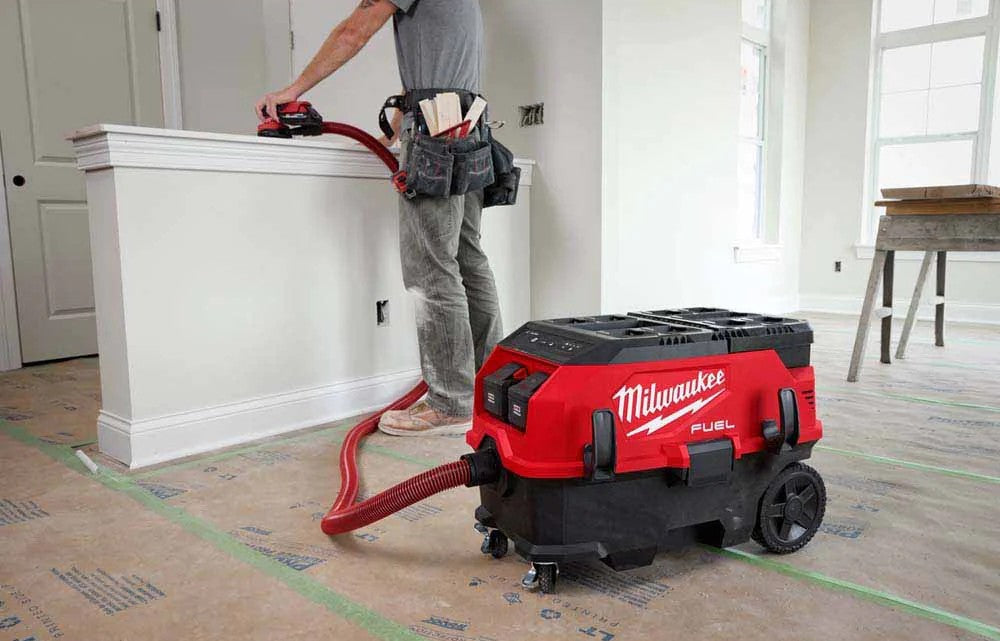
Milwaukee's dust extractors are designed specifically for this type of work. With HEPA filtration, automatic filter cleaning on select models, and compatibility with Milwaukee drilling and cutting tools, they're built to help capture dust at the source and support OSHA compliance requirements.
In this guide, we'll look at Milwaukee's current dust extraction lineup, including the M18 FUEL™ 9-Gallon Dust Extractor, the 8-Gallon Corded Dust Extractor, and HAMMERVAC™ attachments for rotary hammers. We'll also cover HEPA filtration, OSHA Table 1 requirements, and how to choose the right dust collection solution for your work.
Why Silica Dust Is More Than Just a Nuisance

Concrete, brick, block, mortar, stone, and engineered stone all contain crystalline silica. When you cut, grind, drill, or chip into those materials, you kick up dust particles small enough to breathe in without knowing it.
According to OSHA, approximately 2.3 million workers in the U.S. are exposed to respirable crystalline silica on the job. That exposure is linked to silicosis, a progressive, incurable lung disease, as well as lung cancer and kidney disease.
OSHA puts it plainly in its guidance: workers who inhale fine particles of crystalline silica can develop serious, sometimes fatal, lung diseases. That's why the agency created the Respirable Crystalline Silica standard in 2016, and it applies to construction workers across the board.
What Is OSHA Table 1 and Why Does It Matter?
OSHA's Respirable Crystalline Silica standard for construction (29 CFR 1926.1153) gives employers two paths to compliance. The first is to measure workers' air exposure and keep it below the permissible exposure limit, or PEL, of 50 micrograms per cubic meter of air as an 8-hour time-weighted average.
The second path is simpler and what most contractors use. That's Table 1. OSHA describes it this way: "Employers can either use the control methods laid out in Table 1 of the construction standard, or they can measure workers' exposure to silica and independently decide which dust controls work best."
Here's what makes Table 1 so useful on the job. When you follow it, you don't have to do air monitoring constantly, and all you have to do is use the right dust controls, like a dust extractor. For handheld and stand-mounted drills, including rotary hammer drills used in rock and concrete, Table 1 requires using a vacuum dust collection system with a HEPA filter. That's exactly what Milwaukee dust extractors are built to do.
OSHA also requires that construction employers covered by the standard establish a written exposure control plan, designate a competent person to implement it, restrict dry sweeping practices where feasible alternatives exist, offer medical exams for workers required to wear a respirator 30 or more days per year, train workers on silica hazards, and keep exposure records.
For most contractors and electricians doing concrete work, Table 1 compliance means pairing the right dust extractor with your rotary hammer. If you want to dig deeper into the OSHA angle for rotary hammers and grinders specifically, check out our blog on OSHA Silica Table 1 Compliance for Milwaukee Rotary Hammers and Angle Grinders.
Dust Extractor vs. Shop Vac: What's the Difference?

This is a question that comes up a lot. Both suck up debris. Both look similar on a job site. But they're not the same tool.
A shop vac is designed to pick up wood chips, water, and general debris. Most shop vacs have filters rated to capture larger particles, but they're not designed to trap the ultra-fine silica dust that comes from drilling or grinding concrete.
A dust extractor uses HEPA filtration. HEPA filters are rated to capture 99.97% of particles at 0.3 microns or larger. Silica dust particles fall within that size range, which is why HEPA is the minimum standard for this kind of work under OSHA's Table 1 rules.
Milwaukee dust extractors are also built with automatic filter cleaning systems, sealed airflow paths, and VACLINK technology that turns the extractor on and off automatically when you trigger your tool. That's functionality a shop vac doesn't have.
The Milwaukee Dust Extractor Lineup
Milwaukee currently offers several dust extractor options, and they're not all designed for the same type of work.
M18 FUEL 9-Gallon Dual Battery Dust Extractor (0888-20)

The 0888-20 is Milwaukee's flagship cordless dust extractor. It runs on the M18 battery platform, uses two M18 batteries simultaneously for maximum runtime, and holds 9 gallons before it needs to be emptied. If you need HEPA-rated dust extraction on a job site without a cord, this is the unit.
The standout feature is VACLINK technology. When you plug a compatible M18 FUEL tool into the extractor's accessory outlet, the extractor starts automatically when you pull the trigger and shuts off a few seconds after you let go. There's no reaching over to flip a switch between cuts. It just works.
The 0888-20 is also fully PACKOUT compatible. That means you can integrate it with PACKOUT boxes and connect it to your organized PACKOUT system on a van, truck bed, or trailer. For contractors who use PACKOUT across the board, that compatibility makes transport and storage cleaner.
It also features an automatic filter cleaning system that pulses the filter to clear accumulated dust and maintain suction. On a full day of drilling, that keeps performance consistent without stopping to manually clean the filter.
|
Spec |
Detail |
|
Model |
0888-20 |
|
Power Source |
M18 Dual Battery (cordless) |
|
Capacity |
9 Gallons |
|
Filtration |
HEPA |
|
VACLINK |
Yes (automatic tool start/stop) |
|
PACKOUT Compatible |
Yes |
|
Auto Filter Cleaning |
Yes |
|
Platform |
M18 FUEL |
8-Gallon Dust Extractor (8960-20)

The 8960-20 is Milwaukee's corded 8-gallon dust extractor. It's designed for situations where a consistent power source is available and you don't want to worry about battery life during a long shift of concrete work. Think of it as the shop-based or stationary work option.
Like the M18 FUEL model, the 8960-20 is built for silica dust capture with HEPA filtration. It's a solid choice for electrical contractors working in mechanical rooms, utility areas, or anywhere with steady AC power. It's also a good fit for crews doing extended drilling or grinding work on new construction where a cord is practical.
The corded design means consistent, uninterrupted suction for as long as you need it. If battery management between tasks isn't something you want to think about, the 8960-20 keeps things simple.
|
Spec |
Detail |
|
Model |
8960-20 |
|
Power Source |
Corded (120V AC) |
|
Capacity |
8 Gallons |
|
Filtration |
HEPA |
|
Best Use |
Shop, panel work, extended corded tasks |
HAMMERVAC Vacuum Assisted Dust Extractor (5261-DE)

The 5261-DE isn't a standalone unit. It's an attachment that pairs with your existing SDS Plus rotary hammer and connects to your wet/dry vacuum or dust extractor hose. OSHA references handheld drills and rotary hammer work specifically in Table 1, and the HAMMERVAC is designed to meet that requirement in a compact, job-site-ready package.
Here's how it works. The HAMMERVAC attaches to the side handle of your SDS Plus rotary hammer using one of the three included clamping collar assemblies. Your drill bit passes through the dust collection nozzle, which captures dust right at the source as you drill. The vacuum hose connects your existing wet/dry vacuum to the extractor using a standard hose connection.
According to Milwaukee, the HAMMERVAC is compatible with standard hose sizes of 1-1/4 in., 1-1/2 in., 1-7/8 in., and 2-1/2 in. It's also described as "compatible with major brands of SDS Plus rotary hammers," so you're not locked into a Milwaukee rotary hammer to use it.
The adjustable depth stop and ruler make it easy to set precise hole depths. The nozzle is designed so the SDS bit passes through it, which Milwaukee describes as "deburring drilling to collect dust." It's the most cost-effective path to Table 1 compliance on rotary hammer work if you already have a wet/dry vacuum.
|
Spec |
Detail |
|
Model |
5261-DE |
|
Type |
Vacuum-assisted rotary hammer attachment |
|
Compatible Hose Sizes |
1-1/4", 1-1/2", 1-7/8", 2-1/2" |
|
Compatible Drills |
Major brands of SDS Plus rotary hammers |
|
Includes |
(3) side handle clamping collar assemblies, adjustable depth stop, ruler |
|
OSHA Table 1 Relevant |
Yes (handheld drills, concrete) |
Understanding HEPA Filtration

HEPA stands for High Efficiency Particulate Air. A filter is only rated as HEPA if it captures 99.97% of particles at 0.3 microns in diameter or larger. That's the technical standard established by the U.S. Department of Energy.
Respirable crystalline silica particles are small enough to reach deep into your lungs. They range from roughly 0.5 to 10 microns. HEPA filtration is built specifically to capture particles in that range, which is exactly why OSHA's Table 1 requires it for drilling and grinding operations in concrete and masonry.
Standard shop vac filters don't meet that standard. If you're running a regular shop vac while drilling into concrete, you may actually be recirculating fine silica dust back into the air. A HEPA-rated dust extractor like the 0888-20 or 8960-20 captures it and holds it inside the unit.
What Is VACLink Technology?

VACLink is Milwaukee's system that links the 0888-20 M18 FUEL dust extractor to compatible M18 FUEL tools. When VACLink is active, the extractor powers on the moment you pull the trigger on a paired tool and shuts down a few seconds after you stop. No separate switch, no reaching over.
It also works through a corded accessory outlet on the extractor. Plug a corded tool into that outlet and the extractor syncs with it the same way.
For contractors making dozens of holes in a day, this feature alone saves real time. It also reduces the chance someone forgets to run the extractor and ends up drilling without dust collection running. On a job site with OSHA Table 1 requirements, that matters.
PACKOUT Compatibility

The 0888-20 M18 FUEL 9-gallon dust extractor integrates with Milwaukee's PACKOUT modular storage system. That means it can be stacked with, secured to, or used alongside PACKOUT boxes, rolling carts, and mounting systems.
For contractors who already organize tools in PACKOUT, this is a meaningful feature. You can load the dust extractor onto your truck alongside your rotary hammer kit, anchor bits, and other consumables, all within the same system. It keeps gear from shifting around in the van and makes setup faster when you arrive on site.
Which Milwaukee Dust Extractor Is Right for You?
If you're working job sites without reliable power and need HEPA-compliant dust extraction from a cordless unit, the 0888-20 is the right call. The dual battery setup gives you the runtime for a full day, VACLink handles the automation, and PACKOUT integration keeps your kit organized.
If you have access to a cord and you're doing extended work in a fixed location, the 8960-20 is a straightforward, solid option. You get HEPA filtration without battery management.
If you're a masonry or concrete worker who mainly needs Table 1 compliance for rotary hammer drilling and you already own a wet/dry vac, the 5261-DE HAMMERVAC attachment is the most cost-effective starting point. You don't need a dedicated extractor unit. The attachment turns your existing vacuum into a compliant dust collection system.
For most electricians and construction contractors doing anchor bolt installations, rough-in work, or concrete penetrations, the combination of a Milwaukee rotary hammer with either the 0888-20 or the 5261-DE covers your OSHA Table 1 bases.
Final Thoughts
Silica dust isn't something to take lightly. OSHA's Table 1 requirement for HEPA filtration during drilling operations exists for good reason, and Milwaukee's dust extractor lineup gives you a practical way to stay compliant without slowing down production.
Whether you need a portable cordless unit like the 0888-20 with VACLink and PACKOUT integration, a corded workhorse like the 8960-20, or a compact vacuum-assisted attachment like the 5261-DE for your rotary hammer, there's a Milwaukee dust extractor built for the job.
Frequently Asked Questions
Does a Milwaukee dust extractor replace a respirator under OSHA Table 1?
Not always. OSHA Table 1 specifies both engineering controls and respiratory protection for certain tasks. For handheld drills used indoors or in enclosed areas, Table 1 may also require a respirator depending on the specific conditions of the work. Review the full Table 1 requirements at OSHA.gov to confirm the respirator requirements tied to your specific task and working conditions.
Is the Milwaukee 0888-20 OSHA compliant for silica dust?
Yes. The 0888-20 uses HEPA filtration, which is the standard required under OSHA Table 1 for drilling operations in concrete and masonry. Using it properly, with the extractor connected and running during the drilling operation, is consistent with Table 1 compliance.
Can I use a regular shop vac instead of a Milwaukee dust extractor for concrete drilling?
Not for OSHA Table 1 compliance. Table 1 requires a HEPA filter for drilling operations in concrete and masonry. Standard shop vac filters don't meet the HEPA standard of 99.97% capture efficiency at 0.3 microns.
What's the difference between the Milwaukee 0888-20 and the 8960-20?
The 0888-20 is a cordless M18 FUEL unit with 9-gallon capacity, dual battery operation, PACKOUT compatibility, and VACLink. The 8960-20 is a corded 8-gallon unit that runs on 120V AC. The corded model is better suited for fixed workstations with reliable power, while the cordless model is designed for job sites without power access.
Does the HAMMERVAC (5261-DE) work with brands other than Milwaukee rotary hammers?
Yes. Milwaukee describes the 5261-DE as compatible with major brands of SDS Plus rotary hammers. It connects at the side handle position and uses a universal vacuum attachment system with standard hose sizes.
What's VACLink technology on Milwaukee dust extractors?
VACLink is Milwaukee's system that automatically starts and stops the dust extractor when you use a compatible M18 FUEL tool. When you pull the trigger on the paired tool, the extractor turns on. When you let go, it shuts down after a short delay. It eliminates the need to manually switch the extractor on and off between operations.
What does HEPA mean in terms of filtration performance?
HEPA stands for High Efficiency Particulate Air. A HEPA filter captures 99.97% of particles at 0.3 microns or larger. That standard is important for silica dust control because crystalline silica particles are fine enough to reach deep lung tissue and cause disease when inhaled.