


Table of contents
Silica dust is one of the most serious and pervasive health hazards in the electrical, construction, and mechanical trades.
Every time you drill into concrete, grind a masonry surface, or run an angle grinder on a slab, you generate respirable crystalline silica -- particles so small you can't see them, and so dangerous that prolonged exposure causes irreversible lung disease. OSHA has made the requirements around this hazard federally enforceable for construction since 2017, and inspectors are actively citing employers who are not complying.
The regulation electricians, mechanical contractors, and general trades workers need to understand is 29 CFR 1926.1153 Table 1, also known simply as OSHA Silica Table 1. It lists the specific engineering controls and work practices required for 18 common construction tasks, including rotary hammer drilling and handheld grinding.
If you follow Table 1 correctly for a given task, you don't need to perform air monitoring for silica exposure on that task. That's a significant compliance advantage, and it's built around specific tool setups -- most of which Milwaukee has engineered products to meet.
What Is Respirable Crystalline Silica and Why Does It Matter?

Crystalline silica is a compound found in concrete, brick, block, mortar, stone, and most masonry materials. When those materials are cut, drilled, ground, or chipped with power tools, they generate airborne dust particles. The dangerous ones are the respirable fraction -- particles small enough to pass through the nose and throat and reach deep into the lungs, typically 10 microns or smaller.
Short-term exposure to high concentrations can cause acute silicosis. Long-term exposure to lower concentrations causes progressive scarring of lung tissue -- a disease called silicosis -- that is irreversible and has no cure. OSHA estimates that around 2.3 million construction workers are exposed to crystalline silica on the job, and the agency expects its silica rule to prevent over 600 deaths per year from silica-related disease once fully implemented.
OSHA's permissible exposure limit (PEL) for respirable crystalline silica is 50 micrograms per cubic meter of air (50 µg/m3), averaged over an 8-hour shift. The action level -- the concentration at which employers must begin additional controls -- is 25 µg/m3. These are not abstract numbers: a few minutes of heavy grinding or drilling in an enclosed space without dust controls can exceed the PEL by orders of magnitude.
What Is OSHA Table 1?

OSHA's Silica Standard for Construction (29 CFR 1926.1153) offers employers three options for compliance: perform air monitoring and use controls to stay under the PEL; use a written control plan with engineering controls verified by monitoring; or follow Table 1. For most contractors running common concrete and masonry tasks, Table 1 is the most practical path.
Table 1 lists 18 specific construction tasks -- each defined by equipment type and application -- and for each one specifies the exact engineering controls, work practices, and respiratory protection required. If you fully and properly implement those controls as written, you are in compliance for that task and do not need to perform silica air monitoring. That eliminates a significant testing and documentation burden for tasks that match the Table 1 descriptions.
The key word is "fully and properly." The controls listed in Table 1 are minimum requirements, not best practices. The dust collector must meet the airflow specified, the filter must be maintained, the shroud or attachment must be installed and intact as the manufacturer requires, and the operator must follow the prescribed work practices. Partial compliance does not count.
Important Distinction
Table 1 compliance eliminates the need for air monitoring on covered tasks. It does not eliminate the need for a written exposure control plan, which is required separately under 29 CFR 1926.1153. Employers must still document their Table 1 controls in writing as part of the overall exposure control plan.
Table 1 Requirements: Rotary Hammers and SDS Drills
Engineering Controls Required |
Filter Requirement |
Respirator: Under 4 hrs/shift |
Respirator: Over 4 hrs/shift |
|
Row (vii) — Handheld and stand-mounted drills including rotary hammers |
Dust shroud or cowling with dust collection system. Airflow must meet manufacturer spec or greater. Maintain per manufacturer instructions. |
99% efficiency minimum. Filter cleaning mechanism required. |
None required |
APF 10 (half-face respirator) |
How Milwaukee Meets the Rotary Hammer Requirement

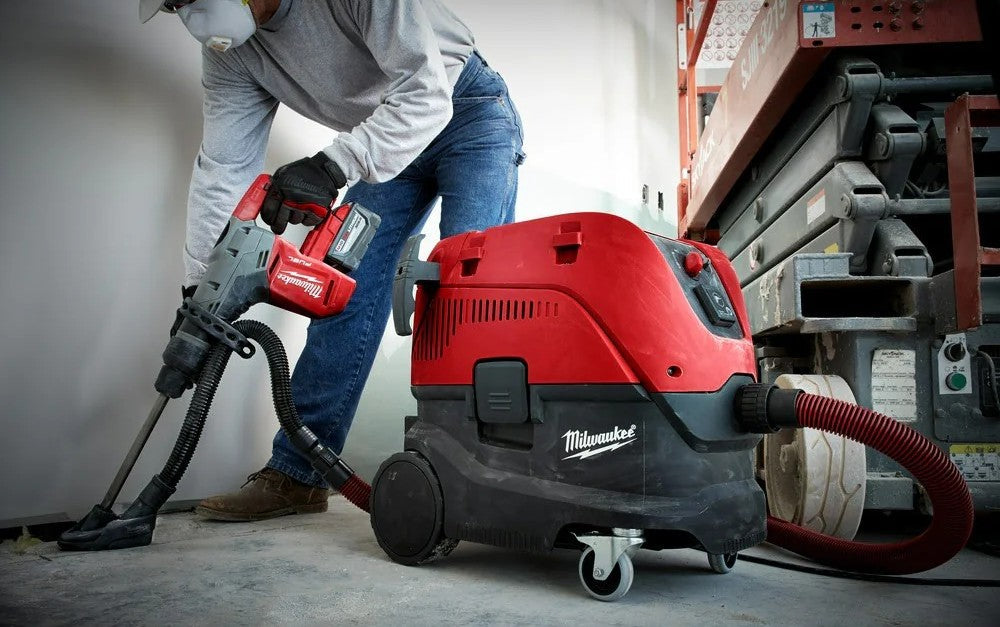
Milwaukee's answer for rotary hammer Table 1 compliance is the HAMMERVAC system -- a line of dedicated and universal dust extractors that attach directly to Milwaukee SDS Plus rotary hammers and capture silica dust at the point of creation. There are two categories: dedicated extractors that are engineered and powered by specific Milwaukee M18 FUEL hammer models, and the M12 HAMMERVAC Universal, which clips to any SDS Plus rotary hammer or hammer drill from any brand.
All HAMMERVAC units use HEPA filters that capture 99.97% of particles 0.3 microns or greater -- well above the 99% Table 1 minimum. The newer M18 FUEL dedicated units include AUTOPULSE, Milwaukee's automatic filter cleaning mechanism that cleans the filter after each use to maintain suction without requiring the operator to stop work and manually clean or change the filter. This matters because a clogged filter reduces airflow below the required level, which would put the setup out of compliance. AUTOPULSE keeps airflow consistent automatically.
Each dedicated HAMMERVAC has a specific compliance range based on the bit diameter and hole depth it is certified for. Confirm that your application falls within the HAMMERVAC's stated compliance range before assuming you are covered.
Milwaukee HAMMERVAC Compliance Ranges
Each dedicated HAMMERVAC is certified for a specific maximum bit diameter and hole depth. Drilling outside those limits with the HAMMERVAC attached does not constitute Table 1 compliance. Always verify the compliance range for your specific extractor model against your actual drilling diameter and depth.
Once you've confirmed your application falls within the compliance range, the next question is usually which hammer and extractor combination to buy. Milwaukee offers several kit configurations that bundle both together. The 2912-22DE, 2914-22DE, 2908-22DE, 2915-22DE, and 3311-22 all ship with extraction included, taking the compatibility guesswork out of the equation.
If you already own a compatible M18 FUEL hammer or prefer to source them separately, these models pair with Milwaukee's dedicated HAMMERVAC units:
- Milwaukee 2912-20 M18 FUEL 1" SDS Plus Rotary Hammer
- Milwaukee 2915-20 M18 FUEL 1-1/8" SDS Plus Rotary Hammer
- Milwaukee 2908-20 M18 FUEL 5/8" SDS Plus Rotary Hammer
- Milwaukee 2916-20 M18 FUEL 1-1/4" SDS Plus D-Handle Rotary Hammer w/ ONE-KEY
- Milwaukee 2916-22 M18 FUEL 1-1/4" SDS Plus D-Handle Rotary Hammer Kit w/ ONE-KEY
- Milwaukee 2912-22 M18 FUEL 1" SDS Plus Rotary Hammer Kit
- Milwaukee 2613-20 M18 Brushless 1" SDS Plus D-Handle Rotary Hammer
Always confirm the HAMMERVAC model you select is the correct dedicated unit for your specific hammer before assuming you're covered.
One model that stands apart is the 2717-20 M18 FUEL 1-9/16" SDS Max Rotary Hammer. The standard HAMMERVAC units are designed for SDS Plus tools and don't attach to SDS Max chucks. For SDS Max drilling on concrete or masonry, Milwaukee's SDS Max dust extraction attachments are the correct solution for that platform.
Table 1 Requirements: Hadheld Grinders (General Grinding)
Handheld angle grinders used for surface grinding, cutting, and surface prep on concrete and masonry fall under Table 1 Row (x): "Handheld grinders for uses other than mortar removal." The rule offers two engineering control options: continuous water application to the grinding wheel, or a vacuum dust collection system with a shroud attachment. Most job sites use the vacuum system for convenience and to avoid water damage to surrounding materials.
The critical specification for the vacuum system option is airflow. OSHA Table 1 requires 25 CFM of vacuum airflow per inch of grinding wheel diameter. This is a hard number. The filter must also have 99% or greater efficiency and include a filter cleaning mechanism.
Minimum Vacuum CFM by Wheel Size
Grinding Wheel Diameter |
Minimum Vacuum CFM Required |
Milwaukee 8960-20 (148 CFM) |
4" wheel |
100 CFM |
Compliant |
4-1/2" wheel |
112.5 CFM |
Compliant |
5" wheel |
125 CFM |
Compliant |
7" wheel |
175 CFM |
NOT Compliant -- need higher CFM extractor |
9" wheel |
225 CFM |
NOT Compliant -- need higher CFM extractor |
The Milwaukee 8960-20 8-Gallon Dust Extractor delivers 148 CFM with its automatic filter cleaning mechanism engaged. That makes it compliant for 4" through 5" grinding wheels when paired with a Milwaukee dust shroud. For 7" or 9" wheels, a higher-CFM extractor is required -- the Milwaukee 0888-20 9-Gallon Dual Battery Dust Extractor is worth evaluating for those applications, along with verifying its rated CFM against the 175 CFM minimum for 7" wheels. The 8960-20 also does not suffice for 7" tuckpointing -- that application has its own requirements covered in the next section.
The practical takeaway: if your crew uses 4-1/2" or 5" angle grinders for surface grinding on concrete, the Milwaukee 49-40-6200 surface-grinding dust shroud, combined with the 8960-20 extractor, gives you a complete, manufacturer-endorsed, OSHA Table 1-compliant setup. If you are running a 7" or larger wheel, you need to step up to a higher-CFM vacuum and verify compliance separately.
Note also that Table 1 requires the CFM rating of the wheel actually in use, not the maximum wheel the grinder can accept. If you use a 5" wheel on a grinder capable of accepting a 7" wheel, you only need 125 CFM for that setup -- but you need to actually be using the 5" wheel.
For crews running 4-1/2" or 5" wheels, here are the Milwaukee angle grinders that work within that compliant setup:
- Milwaukee 2880-20 M18 FUEL 4-1/2" / 5" Grinder (Paddle Switch, No-Lock)
- Milwaukee 2881-20 M18 FUEL 4-1/2" / 5" Grinder (Slide Switch, Lock-On)
- Milwaukee 2886-20 M18 FUEL 5" Flathead Braking Grinder
- Milwaukee 2889-20 M18 FUEL Variable Speed Braking Grinder (Slide Switch)
- Milwaukee 2888-20 M18 FUEL Variable Speed Braking Grinder (Paddle Switch)
- Milwaukee 2882-20 M18 FUEL Braking Grinder w/ ONE-KEY (Paddle Switch)
- Milwaukee 2883-20 M18 FUEL Braking Grinder w/ ONE-KEY (Slide Switch)
- Milwaukee 2986-20 M18 FUEL Dual-Trigger Braking Grinder
- Milwaukee 2880-22 M18 FUEL Grinder Kit (Paddle Switch)
- Milwaukee 3670-20 M18 FUEL 4-1/2"–6" Braking Grinder (Paddle Switch)
- Milwaukee 3671-20 M18 FUEL 4-1/2"–6" Braking Grinder (Slide Switch)
- Milwaukee 3672-20 M18 FUEL Variable Speed Braking Grinder w/ ONE-KEY
- Milwaukee 2686-20 M18 Brushless 4-1/2" / 5" Cut-Off Grinder
- Milwaukee 6130-33 7.0 Amp 4-1/2" Small Angle Grinder
- Milwaukee 6142-31 4-1/2" 11A Small Angle Grinder
- Milwaukee 6142-30 4-1/2" 11A Small Angle Grinder (Lock-On)
For 7" and 9" work, the Milwaukee 6088-30 7"/9" 15 Amp Grinder is the model in this lineup built for those wheel sizes. As covered above, that puts you outside what the 8960-20 can handle — you'll need a higher-CFM extractor and need to verify that setup meets the 175 CFM minimum before treating it as Table 1 compliant.
Table 1 Requirements: Handheld Grinders for Tuckpointing
Tuckpointing -- using an angle grinder to remove mortar from masonry joints -- is treated separately under Table 1 Row (ix) and carries stricter requirements than general surface grinding. Mortar removal generates extremely high concentrations of respirable silica in a short time. The engineering control requirement is the same CFM-per-inch vacuum system, but tuckpointing has two additional requirements that general grinding does not: a HEPA filter is required (not just 99% efficiency), and the filter cleaning mechanism must meet a higher standard.
Tuckpointing vs. General Grinding: Key Differences
Requirement |
General Grinding (Row x) |
Tuckpointing (Row ix) |
Minimum Vacuum CFM |
25 CFM per inch of wheel |
25 CFM per inch of wheel |
Filter Efficiency |
99% or greater |
HEPA (99.97%+) required |
Filter Cleaning Mechanism |
Required |
Required |
Shroud Required |
Yes, intact and per manufacturer spec |
Yes, intact and per manufacturer spec |
Respirator: Under 4 hrs/shift outdoors |
None required |
APF 10 required |
Respirator: Under 4 hrs/shift indoors |
APF 10 required |
APF 10 required |
Respirator: Over 4 hrs/shift |
APF 10 required |
APF 10 required |
For tuckpointing, a respirator at APF 10 (such as a half-face air-purifying respirator) is required at all times regardless of shift duration or whether the work is indoors or outdoors. This is stricter than general grinding, where no respirator is required for outdoor work under four hours per shift. Make sure your crew knows the difference, because the tasks look similar but the compliance setup is not.
The Milwaukee 8960-20 dust extractor's two-step filtration system includes a HEPA filter as the final stage, which captures 99.97% of particles 0.3 microns or greater. When paired with a Milwaukee dust shroud, this setup meets the HEPA filter requirement for tuckpointing -- but you still need to verify CFM against wheel size and ensure the shroud is designed for tuckpointing/mortar removal applications. Using a surface grinding shroud for tuckpointing may not provide the right geometry to capture mortar removal dust effectively.
Respiratory Protection: When Is It Required?
One of the most common misunderstandings about Table 1 is the relationship between engineering controls and respirators. Dust collection does not automatically eliminate the respirator requirement—it depends on the task, the work duration, and whether the work is indoors or outdoors. Here is a practical summary for rotary hammers and grinders:
Respirator Requirement Quick Reference
Task |
Location |
Duration |
Respirator Required? |
Minimum APF If Required |
Rotary hammer / SDS drill |
Outdoors |
Under 4 hrs/shift |
No |
-- |
Rotary hammer / SDS drill |
Outdoors |
Over 4 hrs/shift |
Yes |
APF 10 |
Rotary hammer / SDS drill |
Indoors / enclosed |
Under 4 hrs/shift |
No |
-- |
Rotary hammer / SDS drill |
Indoors / enclosed |
Over 4 hrs/shift |
Yes |
APF 10 |
Grinder -- general grinding |
Outdoors |
Under 4 hrs/shift |
No |
-- |
Grinder -- general grinding |
Outdoors |
Over 4 hrs/shift |
Yes |
APF 10 |
Grinder -- general grinding |
Indoors / enclosed |
Under 4 hrs/shift |
Yes |
APF 10 |
Grinder -- general grinding |
Indoors / enclosed |
Over 4 hrs/shift |
Yes |
APF 10 |
Grinder -- tuckpointing |
Any location |
Any duration |
Yes -- always |
APF 10 |
APF 10 means an Assigned Protection Factor of 10 -- the respirator reduces the worker's exposure by a factor of at least 10. A standard NIOSH-approved half-face air-purifying respirator with appropriate cartridges meets this requirement. Full compliance with the respirator requirement also means proper selection, fit testing, and maintenance per OSHA's Respiratory Protection Standard (29 CFR 1910.134). Dust collection does not substitute for a properly fitted respirator when one is required.
Note on "4 Hours Per Shift"
The 4-hour threshold under Table 1 refers to continuous time actively performing the task -- not total shift length, and not cumulative task time across stops and starts. If your crew drills for 90 minutes, breaks for other work, then drills again for 90 minutes, that may not count as 4 continuous hours. However, if multiple Table 1 tasks are performed in a shift and their combined duration exceeds 4 hours, the longer-duration respiratory protection requirements apply to all of them. When in doubt, consult OSHA guidance or a qualified industrial hygienist.
Final Thoughts
OSHA Silica Table 1 is not complicated once you understand what it is asking for: the right shroud or cowling, the right vacuum airflow for the wheel size, a 99%+ efficient filter with a cleaning mechanism, and a respirator when the task duration or location requires one. The engineering controls are well-defined, and Milwaukee has built a product line that maps directly to each Table 1 application for rotary hammers and angle grinders.
The critical practical points to carry off this page: make sure the CFM of your dust extractor matches the wheel size you are using, confirm your HAMMERVAC is the right model for your specific hammer, verify your drilling is within the compliance range for that unit, and remember that a respirator is still required for tuckpointing regardless of your dust setup, and for all indoor grinding work. Document your controls in a written exposure control plan as required by the standard.
All Milwaukee dust management products referenced in this guide are available through Red Tool Store -- from the full HAMMERVAC lineup (5/8" through 1-1/4" dedicated units and the M12 Universal), to the SDS Max attachments for drilling, chipping, and dry coring, to the 8960-20 and 0888-20 dust extractors, to the grinder shrouds and the 0950-20 wireless dust control adapter.
Frequently Asked Questions
Do I have to do air monitoring for silica if I follow Table 1?
No. If you fully and properly implement the engineering controls and work practices listed in Table 1 for a specific task, you are not required to perform air monitoring for silica exposure on that task. This is the primary compliance advantage of Table 1. However, if your task does not match a Table 1 description, or if you cannot fully implement the listed controls, you must fall back to the alternative compliance methods that require monitoring.
Does a HEPA filter always have to be used for silica work?
No. Table 1 requires a filter with 99% or greater efficiency for most applications -- not specifically HEPA. HEPA filters are certified to 99.97% efficiency, which exceeds the requirement, but a non-HEPA 99% filter is technically compliant for most Table 1 tasks. The two specific Table 1 tasks that require HEPA are: cleaning holes prior to epoxy anchor installation, and tuckpointing (mortar removal with grinders). The Milwaukee 8960-20 includes a HEPA filter as the final stage of its two-step system, meeting both the standard and the HEPA-specific requirements.
Can I use any SDS Plus rotary hammer with the M12 HAMMERVAC Universal?
Milwaukee states the M12 HAMMERVAC Universal is compatible with most major brands of SDS Plus rotary hammers and AC/DC hammer drills via its side-handle clamping collar assemblies. It is not guaranteed to fit every rotary hammer on the market, so verify fitment with your specific tool before assuming compliance. The dedicated HAMMERVAC units -- the 2908-DE (5/8"), 2912-DE (1"), 2915-DE (1-1/8"), and 2916-DE (1-1/4") -- are the most reliable path for compliance when running M18 FUEL hammer models, since they are engineered and certified specifically for those tools.
What CFM do I need for a 7" angle grinder?
A 7" grinding wheel requires 175 CFM (25 CFM x 7 inches). The Milwaukee 8960-20 delivers 148 CFM, which is not sufficient for a 7" wheel. The Milwaukee 0888-20 M18 FUEL 9-Gallon Dual Battery Dust Extractor is a higher-output option to evaluate -- confirm its rated CFM spec against the 175 CFM requirement before pairing it with a 7" wheel application.
Is a respirator still required when using a dust extraction system?
It depends on the task, location, and shift duration. For rotary hammer drilling, no respirator is required for tasks under 4 continuous hours per shift, indoors or outdoors. For general surface grinding outdoors under 4 hours, no respirator is required. For general surface grinding indoors -- regardless of duration -- a respirator at APF 10 is required. For tuckpointing, a respirator at APF 10 is required at all times regardless of location or duration. Dust extraction controls exposure but does not eliminate the need for respiratory protection when Table 1 requires it.
Does a regular shop vacuum work for Table 1 compliance?
Not in most cases. Standard shop vacuums typically lack a filter with 99%+ efficiency, and they rarely have a filter cleaning mechanism. Both are required under Table 1. Additionally, many shop vacuums do not meet the CFM thresholds required for grinder applications. A purpose-built dust extractor like the Milwaukee 8960-20, which is specifically engineered to meet OSHA's 29 CFR 1926.1153 requirements, is the appropriate tool for Table 1 compliance.
Where can I find more information on OSHA's silica requirements?
The full text of OSHA's Silica Standard for Construction is at osha.gov/laws-regs/regulations/standardnumber/1926/1926.1153. OSHA also publishes Table 1 fact sheets for specific equipment types including rotary hammers, grinders, and tuckpointing at osha.gov. Milwaukee's own dust management resource page at milwaukeetool.com provides product-specific guidance on how their tools comply with 29 CFR 1926.1153.