


Table of contents
Milwaukee Hedge Trimmer Guide: Standard, Pole, and QUIK-LOK Models
If you're managing property, maintaining landscapes, or running a landscaping business, you need a good hedge trimmer. Milwaukee's hedge trimmer lineup includes standard hand-held models, pole trimmers for overhead reach, and articulating models for difficult angles.
They're all powered by M18 REDLITHIUM batteries, which means they integrate seamlessly with your existing Milwaukee cordless tools. No gas, no oil mixing, no pull cords.
In this guide, we'll walk through the different trimmer types, explain blade lengths and cutting capacity, and help you choose the right model for your specific work. Whether you're trimming property lines, maintaining mature hedges, or doing commercial landscape work, Milwaukee has a trimmer built for the job.
Why Go Cordless with Hedge Trimmers?
Cordless hedge trimmers changed the game for landscapers and property maintenance crews. A gas trimmer needs fuel mixed at the right ratio, spark plug maintenance, carburetor cleaning, and seasonal storage care. A cordless trimmer doesn't. You charge the battery, grab the trimmer, and start cutting. The weight is lower because there's no gas tank or oil reservoir.
Battery-powered trimmers are quieter, which means you can work in residential areas without disturbing neighbors during early mornings or late afternoons. You don't have exhaust fumes in your face. And since you're using M18 batteries, you can swap between trimmers, chainsaws, blowers, and other M18 tools without buying separate battery systems. One power platform powers your whole lineup.
Standard vs. Pole Trimmers: Knowing Which You Need

Standard Hedge Trimmers: Power and Control
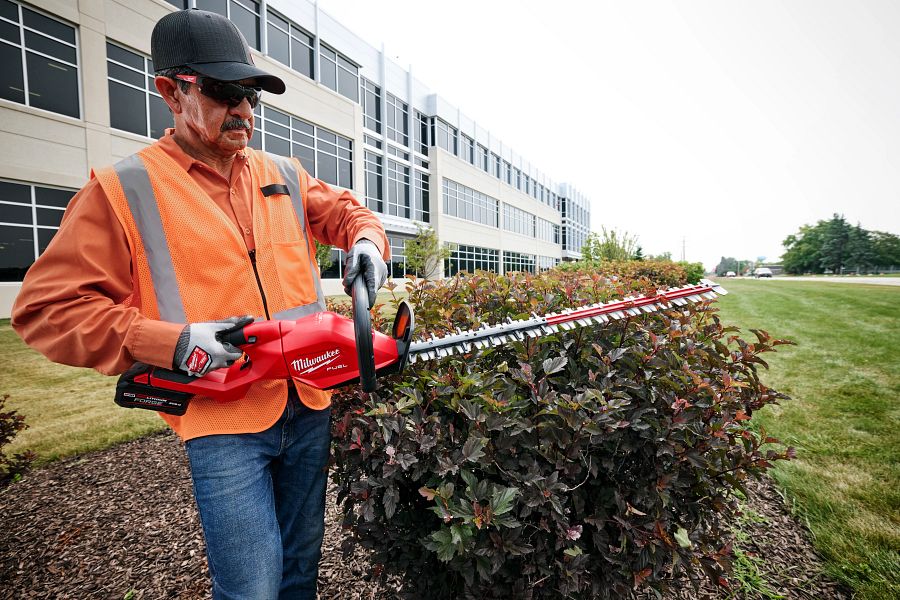
Standard hedge trimmers are hand-held with a straight or slightly angled blade. You hold them at waist or chest height and cut horizontal lines into hedges. They're heavier because of the blade motor, but you've got full control and excellent power. The blade delivers 3,200 strokes per minute, which is fast enough to cut through thick stems and woody growth. Standard trimmers are best for ground-level hedging, topping mature growth, and working on accessible plants.
If your hedges are at or below shoulder height, a standard trimmer is your go-to tool.
Pole Trimmers: Extended Reach and Accessibility
Pole trimmers have the blade mounted on the end of a long shaft. You don't need a ladder to trim overhead growth.
Milwaukee makes several pole options: short pole for moderate reach, full pole for tall hedges and trees, and extended pole for maximum reach. Some pole trimmers have articulating heads that angle and rotate, giving you access to difficult positions.
Pole trimmers are lighter per unit of reach because the motor hangs at the end of the pole. You're not holding a heavy hand-held trimmer above your head. Instead, you're guiding a lighter pole and letting the motor do the work. They're essential if you're trimming tall hedges, tree branches, or working overhead on mature property.
Blade Length: 24 Inches vs. 30 Inches and How It Matters

24-Inch Blade: Maneuverability and Residential Work
The 24-inch blade is the sweet spot for residential property care and general landscaping. It's not too heavy, it's not too long, and it covers typical hedge widths in one or two passes. You can navigate around obstacles, work in confined spaces, and access the top of hedges without overextending. A 24-inch blade cuts a 3/4-inch stem cleanly. It's fast enough for routine maintenance and sharp enough for precise shaping. If you're trimming property lines, maintaining residential hedges, or doing general landscape care, the 24-inch model is a solid choice.
30-Inch Blade: Production Work and Thick Growth
The 30-inch blade is for contractors doing commercial landscape work or tackling overgrown properties. The longer blade covers more area per pass, which means faster work on large hedges. You can handle thicker stems and faster-growing material. A 30-inch blade is heavier, so you need good stamina for all-day use. But if you're billing by the job and your work involves large properties or thick hedge growth, the 30-inch blade cuts your labor time significantly. You'll cover hedges faster and finish jobs quicker.
Standard Hedge Trimmers: Milwaukee's Hand-Held Lineup

Milwaukee's standard hedge trimmers are the 3033 (24-inch) and 3034 (30-inch). Both use the M18 FUEL platform with brushless motors. They deliver 3,200 strokes per minute and can cut through 3/4-inch diameter stems. The main difference is blade length and work capacity. The 24-inch 3033 is lighter and better for residential properties. The 30-inch 3034 is designed for contractors doing commercial work or large properties. Both come in bare-tool versions (if you already have batteries) and kit versions (with battery and charger).
|
Model |
Blade Length |
Type |
Cutting Capacity |
Best Use |
Platform |
|
3033-20 |
24" |
Standard Hand-Held |
3/4" |
Residential, general property care, light commercial |
M18 FUEL (Tool Only) |
|
3033-21 |
24" |
Standard Hand-Held Kit |
3/4" |
Residential, general property care, light commercial |
M18 FUEL (with Battery) |
|
3034-20 |
30" |
Standard Hand-Held |
3/4" |
Commercial landscaping, large properties, thick growth |
M18 FUEL (Tool Only) |
|
3034-21 |
30" |
Standard Hand-Held Kit |
3/4" |
Commercial landscaping, large properties, thick growth |
M18 FUEL (with Battery) |
Pole and Articulating Trimmers: Reach and Flexibility
Milwaukee's pole lineup includes short-pole models for moderate overhead reach, full-length poles for tall hedges, and extended-pole models for maximum height. Several models have articulating heads that pivot and rotate, giving you access to angles and tight spaces that would be impossible with a straight blade.
The 3043 is a short pole trimmer with a standard blade. The 3012 is a full-length articulating pole. The 3035 is an extended pole articulating trimmer for maximum reach. All use M18 FUEL power and deliver the same cutting performance as hand-held models, just at the end of a pole instead of in your hands.
|
Model |
Type / Reach |
Cutting Capacity |
Reach Capability |
Best Use |
Platform |
|
3043-20 |
Short Pole |
3/4" |
Moderate |
Overhead trimming, ground plus 8 feet |
M18 FUEL (Tool Only) |
|
3043-21 |
Short Pole Kit |
3/4" |
Moderate |
Overhead trimming, ground plus 8 feet |
M18 FUEL (with Battery) |
|
3012-20 |
Full Pole Articulating |
3/4" |
Up to 9+ feet |
Tall hedges, over fences, articulating head |
M18 FUEL (Tool Only) |
|
3012-21 |
Full Pole Articulating Kit |
3/4" |
Up to 9+ feet |
Tall hedges, over fences, articulating head |
M18 FUEL (with Battery) |
|
3035-20 |
Extended Pole Articulating |
3/4" |
Up to 9.5+ feet |
Maximum reach, commercial properties, tall growth |
M18 FUEL (Tool Only) |
|
3035-21 |
Extended Pole Articulating Kit |
3/4" |
Up to 9.5+ feet |
Maximum reach, commercial properties, tall growth |
M18 FUEL (with Battery) |
QUIK-LOK System and M12 Options: Flexibility and Compact Power

QUIK-LOK Articulating Trimmer Attachment
Milwaukee's 49-16-2719 QUIK-LOK articulating hedge trimmer attachment is a game-changer for contractors who already own M18 FUEL power heads. Instead of buying separate pole trimmers, you snap a hedge trimmer head onto any compatible QUIK-LOK power head. The head articulates (angles 135 degrees), giving you flexibility to tackle difficult trimming angles. It's lighter than a dedicated pole trimmer because you're not carrying the motor and battery in the pole. The battery stays in the power head. If you're already invested in M18 FUEL QUIK-LOK tools, this is an economical way to expand your trimming capability.
M12 FUEL 8-Inch Trimmer: Compact Detail Work
The 2533-21 M12 FUEL 8-inch hedge trimmer is the compact option for detail work and light trimming. The 8-inch blade is designed for precision, not production. You use this for shaping, edge trimming, and general maintenance of small hedges or ornamental plantings. It's much lighter than the M18 models and suitable for extended overhead work without fatigue. If you're doing residential detail work or general maintenance, the M12 is sufficient. If you're doing production landscaping work, the M18 24 or 30-inch models are more efficient.
Battery Runtime and Cordless Performance
M18 hedge trimmers run on REDLITHIUM batteries. Runtime depends on cutting conditions. Light material (new growth, thin stems) uses less battery. Heavy material (thick, woody growth) uses more. With a standard XC8.0 battery, you can expect several hours of typical trimming work. For all-day production jobs, bring a spare battery and keep it charged. The advantage of the Milwaukee system is that if you already own M18 batteries from drills, saws, or other tools, they're immediately compatible. You don't need to buy a completely new battery ecosystem. You're just buying the trimmer and swapping batteries from your existing kit.
Hedge Trimmers by Trade and Application

Landscaping and Property Maintenance
Landscapers and property maintenance crews are the primary users of hedge trimmers. The 24-inch standard model (3033) is perfect for regular property maintenance and residential work. The 30-inch model (3034) is ideal for commercial landscaping and large properties. Pole models (3012 or 3035) expand your capability to handle tall hedges and overhead growth that would require ladders with a standard trimmer.
General Contractors and Property Management
General contractors managing properties or doing site work often need to trim overgrown hedges, clear sight lines, or manage landscape overgrowth. The 24-inch standard trimmer handles most contractor trimming tasks. If you're managing multiple properties, the cordless benefit is huge: no fuel, no maintenance headaches, just grab and go.
Arborists and Tree Care Specialists
Arborists trimming ornamental trees and managing landscape plants appreciate the M12 8-inch trimmer or the articulating pole trimmers for detail work at height. The extended articulating pole (3035) gives you reach to tree canopies without climbing or using extensive rigging.
Care and Maintenance: Keeping Your Trimmer Running Sharp
Hedge trimmer maintenance is minimal compared to gas tools. You don't need spark plug maintenance or carburetor cleaning. You do need to keep the blades sharp and clean. Dull blades tear plant material instead of cutting it, which damages the plant and requires more battery power to cut through the same thickness. Clean the blades after each use, especially if you're cutting wet plants or material with dirt. A soft brush removes debris. Sharpen the blades when you notice tearing instead of clean cuts. Most Milwaukee dealers can sharpen blades or provide replacement blade sets.
Store trimmers with the battery removed in a cool, dry place. If you're not going to use a trimmer for several months, charge the battery periodically to keep it healthy. Most M18 batteries will hold a charge for months if stored in a temperature-controlled environment. For regular maintenance, check the blade alignment and make sure the moving parts move freely. A small amount of light oil on the blade pivot points keeps the trimmer running smoothly.
Choosing Your Milwaukee Hedge Trimmer
Milwaukee's hedge trimmer lineup gives you real flexibility. Start with what you actually need: standard models for most property care, pole models for overhead work, and the M12 compact for detail trimming. All are powered by M18 REDLITHIUM batteries that integrate with your existing Milwaukee tools. No gas mixing, no oil changes, no pull cords. Just charge the battery, grab the trimmer, and go trim. Whether you're maintaining a single property or running a landscape crew, there's a Milwaukee trimmer built for your work.
Frequently Asked Questions
How long does a battery last on a full charge?
It depends on cutting conditions. Light trimming of new growth on a typical residential property can run several hours on a single battery. Heavy cutting of thick, woody material uses more power and reduces runtime. For a typical day of property maintenance, one battery is usually sufficient. For all-day production landscaping, bring two batteries so you always have one charging while you work.
Can I use my existing M18 batteries with Milwaukee hedge trimmers?
Absolutely. All M18 FUEL trimmers use standard M18 batteries. If you already own M18 batteries from other tools, they work in any M18 trimmer. This is one of the big advantages of the Milwaukee system. You're not locked into proprietary batteries.
What's the difference between articulating and standard poles?
A standard pole keeps the blade straight and parallel to the pole. An articulating pole has a head that tilts and rotates up to 135 degrees. Articulating poles give you access to angles and tight spaces that you can't reach with a straight pole. If you're trimming around complex shapes, over fences, or in confined areas, articulating is worth the investment.
Is a pole trimmer difficult to use for extended periods?
Not with Milwaukee's design. The weight is distributed along the pole rather than concentrated in your hands. The battery and motor hang at the end of the pole, so you're not supporting a heavy hand-held tool above your head. Most people can work with a pole trimmer for several hours without significant fatigue. The short-pole model (3043) is lighter than full or extended poles and is better if you're concerned about overhead endurance.
Should I buy the 24-inch or 30-inch model?
If you're doing residential and general property care, the 24-inch model is sufficient and lighter to handle. If you're doing commercial landscaping, managing large properties, or dealing with overgrown material, the 30-inch model is more efficient and finishes jobs faster. Consider your typical workload and whether the extra weight is worth the increased cutting capacity.