


Table of contents
If you're still using a bubble level on modern job sites, you're leaving money on the table. Laser levels have become essential for electricians, plumbers, HVAC technicians, framers, and general contractors. They're faster, more accurate, and they work in conditions where bubble levels fail.
Milwaukee's laser level lineup includes line lasers and rotary lasers, in both red and green beam options, powered by M12 and M18 batteries. In this guide, we'll break down the differences between laser types, explain what to look for in specifications, and show you which models are designed for specific trades and applications.
Whether you're hanging ceiling grids, setting electrical runs, establishing grading on a site, or plumbing a wall, there's a Milwaukee laser level built for your work.
Why Laser Levels Matter on Modern Job Sites
A bubble level is great for checking if a shelf is plumb or if you've got a level surface. But it has limits. You can only check the level at one specific location. You have to hold it, read it, and mark your point. It's also subject to user error. Tilt it slightly and your reading is off. A laser level projects a reference line or dot across an entire room. You can see the laser mark at 50 feet as easily as at 5 feet. You don't need to physically touch the tool to every point you're checking. And with modern detectors, you can read laser marks in bright sunlight or across great distances. Laser levels are faster, they're more accurate, and they reduce mistakes that cost time and money to fix.
Line Lasers vs. Rotary Lasers: Understanding the Difference

Line Lasers: Precision at Short to Medium Range
Line lasers project a straight laser line or cross pattern. They're self-leveling, meaning they automatically find the true horizontal (or vertical if you rotate them). Most line lasers have working ranges between 100 and 165 feet with a detector. Without a detector, you can see the line clearly up to 30 or 40 feet in low light. Line lasers are perfect for indoor work: hanging drywall, setting electrical runs, plumbing walls, positioning ceiling grids. They give you a reference line across an entire wall or room. You can see exactly where you need to cut, drill, or fasten. A cross-line laser adds vertical reference points so you can plumb a wall and set a level line simultaneously.
Rotary Lasers: Coverage for Large Areas and Exterior Work

A rotary laser spins a laser beam in a complete 360-degree circle. It establishes a perfectly level reference plane across an entire work area. Working range is much greater: up to 2,000 feet with a detector. Rotary lasers are essential for grading, foundation layout, site leveling, and other outdoor work where you're establishing reference points across a large area. A detector receives the rotating beam and beeps when it's at the correct height. You move the detector around the site and mark elevation points. Rotary lasers are overkill for small indoor rooms but invaluable for any job involving grading, slopes, or multi-area layout.
Red Beam vs. Green Beam: Light Visibility and Use Cases

The color of laser light matters. Red lasers are traditional and work well in most indoor environments. They're bright enough for typical construction interiors. Green lasers are newer technology and are roughly 2-3 times brighter to the human eye than red, especially in bright sunlight or outdoors. If you're working outdoors or in bright natural light, a green laser is much easier to see. For dark basements, interior framing, and typical indoor contractor work, red is fine. For site work, grading, and exterior applications, green is the better choice. Milwaukee makes both red and green options so you can pick what suits your primary work. Some contractors have both: a green rotary laser for site work and a red line laser for interior framing.
Line and Cross-Line Lasers: Milwaukee's Compact Solution
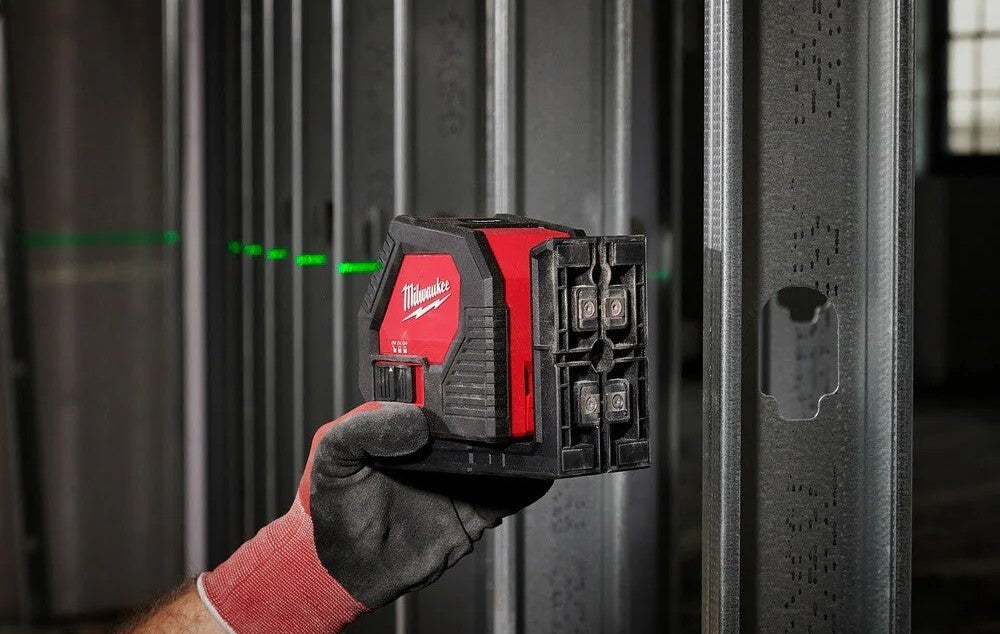
Milwaukee's line laser lineup includes battery-powered cross-line models that project horizontal and vertical laser lines simultaneously. The 3421 is a manual-leveling model that's durable and straightforward. The M12 FUEL series (3622, 3624, 3632) adds motorized self-leveling and increased working range with a detector. These are the workhorses for electricians, plumbers, and carpenters. You'll mount the laser on a tripod or magnetic bracket, set it up, and walk around the room with your reference line. The compact size means they fit in a tool bag and travel between jobs easily.
Model |
Type |
Beam Color |
Power Source |
Working Range |
Best Trade Use |
| 3421 |
Cross-Line |
Green |
Manual |
100 ft |
Interior framing, electrical runs, light commercial |
|
3522-21 |
Cross-Line & Plumb Points |
Green |
USB Rechargeable |
100 ft |
Layout, framing, plumbing, drywall installation |
|
3622-20 |
Cross-Line & Plumb Points |
Green |
M12 (Tool Only) |
165 ft w/ detector |
Professional electrical, plumbing, HVAC, framing |
|
3622-21 |
Cross-Line & Plumb Points Kit |
Green |
M12 (with Battery) |
165 ft w/ detector |
Professional electrical, plumbing, HVAC, framing |
|
3624-20 |
Cross-Line & 4 Points |
Green |
M12 (Tool Only) |
165 ft w/ detector |
Drop ceiling grids, layout points, corner reference |
|
3624-21 |
Cross-Line & 4 Points Kit |
Green |
M12 (with Battery) |
165 ft w/ detector |
Drop ceiling grids, layout points, corner reference |
|
3632-21 |
360 Degree 3-Plane |
Green |
M12 (with Battery) |
165 ft w/ detector |
Framing, drop ceilings, square layout, all-around indoor |
Rotary Lasers: Professional-Grade Site Work and Grading
Milwaukee's rotary laser lineup is powered by M18 REDLITHIUM batteries. These are designed for site contractors, grading specialists, and commercial crews. The 3701 is the red beam exterior model. The 3702 is the green beam interior model. The 3704 adds dual-slope capability for grading and sloped site work. All of them have self-leveling, accuracy specifications of ±1/8 inch at 100 feet, and working ranges up to 2,000 feet with a detector. They're heavier and more robust than line lasers because they're meant to work in rough site conditions.
Model |
Beam Color |
Slope Capability |
Working Range |
Best Trade Use |
|
3701-21 |
Red | No |
2,000 ft w/ detector |
Exterior grading, foundation layout, construction site |
|
3701-21T |
Red | No |
2,000 ft w/ detector |
Exterior grading, site layout, includes tripod & grade rod |
|
3702-21 |
Green | No |
2,000 ft w/ detector |
Indoor layout, large floor plans, brighter in low light |
|
3704-21 |
Red |
Yes (Dual Slope) |
2,000 ft w/ detector |
Grading, drainage, sloped site work, landscape installation |
Laser Levels by Trade: What You Actually Need

Electricians and Electrical Rough-In
Electricians need to run conduit and wire at consistent heights. A cross-line laser (like the 3622 or 3624) gives you a level reference across an entire wall. Set the laser at the height you need your runs, and you've got your guide. The M12-powered models with working range to 165 feet cover typical commercial interiors. The plumb-points feature helps you align vertical runs and verify wall plumb before you start.
Plumbers and HVAC Technicians
Plumbing and HVAC runs need to be installed at consistent slopes and heights. A cross-line laser or a 3-plane laser (3632) gives you horizontal reference and vertical plumb. The 3632's 360-degree 3-plane coverage is especially useful for establishing sloped runs and drainage angles. You can set the laser and walk around with your height reference marked by the laser line.
Framers and Carpenters

Framers use laser levels for ceiling height, top-plate layout, and wall plumb. A cross-line laser establishes level ceilings quickly and marks where your stud layout needs to be. The 3632 3-plane laser covers framing squares and establishes reference points for multi-area projects. You can see your laser marks across the entire framing area without physically checking every point with a bubble level.
Site Contractors and Grading Work
Site contractors need to establish elevation references across large areas. A rotary laser (3701 or 3702) creates a level plane that you can access anywhere on the site with a detector. For grading and drainage, the dual-slope model (3704) allows you to set and follow a specific grade. No more string lines, no more tedious bubble-level checks. You've got a reference plane established by laser that's accurate to better than an inch over hundreds of feet.
Basic Setup and Operation: Getting Accurate Results
Using a laser level is straightforward, but a few setup steps make a difference. First, mount the laser on a stable tripod or secure it to a fixture so it won't move during your work. For line lasers, rotate the laser until it projects the horizontal line or cross pattern you need. The laser will self-level automatically. Check the accuracy by comparing the laser line to a known reference. For rotary lasers, you'll mount it on a tripod, power it on, let it self-level, then use the detector to read the beam at different locations. The detector beeps when it's at the correct elevation.
Battery care matters. M12 and M18 batteries have decent charge retention, but if you're working all day, bring a spare. Mark the laser position with tape if you need to move it and relocate it later. Lasers are sensitive to vibration, so avoid bumping the tripod once you've set up. In bright sunlight, consider using a detector even with line lasers for better accuracy. The detector picks up the laser beam and alerts you with sound when you're at the right elevation.
Choosing Your Milwaukee Laser Level
Laser levels aren't luxury tools anymore. They're productivity tools that save time and reduce errors. Milwaukee's lineup covers every trade application: M12 line lasers for indoor work, M18 rotary lasers for site work, red beams for indoors, green beams for bright environments, and specialized models like dual-slope lasers for grading.
Choose based on where you spend most of your time. If you're primarily doing interior framing, electrical, and plumbing work, a line laser like the 3622 or 3624 is sufficient and more portable. If you're doing site work, grading, or large-area layout, a rotary laser (3701, 3702, or 3704) is essential. Either way, you're making your job faster and more accurate than bubble levels alone can deliver.
Frequently Asked Questions
Can I use a laser level outdoors in sunlight?
Yes, but with caveats. Red beam lasers become less visible in bright sunlight. Green beam lasers are much brighter and easier to see outdoors. For any outdoor work, a detector is essential. The detector picks up the laser beam even when you can't see it with your eyes. For site work and exterior layout, always use a rotary laser with a detector and a green or red beam appropriate to your lighting conditions.
How accurate are Milwaukee laser levels?
Milwaukee's line lasers have accuracy of ±1/8 inch at 30 feet. Rotary lasers are ±1/8 inch at 100 feet. For most construction work, that's well within acceptable tolerance. The limiting factor on accuracy is usually setup. If the laser isn't mounted securely or the surface you're marking is uneven, your final line won't be perfect. But the laser itself is very accurate.
Do I need a detector to use a laser level?
Not always. For indoor work at close range, you can see the laser line directly. But for distance work, bright environments, or outdoor applications, a detector is essential. The detector picks up the rotating beam from a rotary laser or the straight beam from a line laser and alerts you when you're at the correct height. Most professional kits include a detector.
Can I use an M12 laser level with an M18 battery?
No. M12 and M18 batteries are different sizes and connector types. They're not interchangeable. However, if you already own M18 tools, the rotary lasers are M18-powered. If you have M12 tools, the line lasers are M12-powered. Plan your purchases around your existing battery ecosystem.
What's the difference between a plumb point and a cross line?
A cross line projects horizontal and vertical laser lines. Plumb points are additional laser dots that appear directly above and below the laser head, useful for vertical alignment and corner reference. A laser with both cross-line and plumb-points capability (like the 3622 or 3624) gives you the most layout flexibility. You get horizontal reference, vertical reference, and corner dots in one setup.