


Table of contents
Milwaukee nailers use a nitrogen air spring mechanism across its nailer lineup instead of gas cartridges. That means no cartridges to buy, no cartridge maintenance, and no extra weight in the tool. You pull the trigger, and the nail drives, zero ramp-up time, every time.
That nitrogen spring system, combined with Milwaukee's POWERSTATE brushless motor and REDLINK PLUS intelligence, enhances the performance on jobsites.
This guide breaks down every Milwaukee nailer by type, so you can find the right tool based on your team's needs or jobsite specifications.
How Milwaukee Nailers Work: Nitrogen Air Spring Explained
Most cordless nailers on the market use either a gas cartridge or a flywheel motor to drive nails. Gas cartridge tools require you to keep cartridges on hand, and flywheel tools have a spin-up delay that slows you down. Milwaukee's nailers use neither.
The nitrogen air spring system stores energy in a sealed chamber of compressed nitrogen gas. When you pull the trigger, the energy is released instantly and drives the nail. The result is a pneumatic-like firing response with zero ramp-up time. You don't wait for anything. The nail fires the moment you pull the trigger, just like an air gun.
Because there's no gas cartridge involved, you're not adding ongoing consumable costs to your operation. The sealed nitrogen chamber is part of the tool itself and doesn't need to be refilled or replaced under normal use.
One more thing worth knowing: Milwaukee's cordless nailers run exclusively on REDLITHIUM batteries with no gas cartridges at all. Older cordless nailer technology required both a battery and a gas cartridge. Milwaukee's system eliminates the cartridge entirely, which simplifies your kit and cuts out a recurring cost.
Milwaukee Framing Nailers
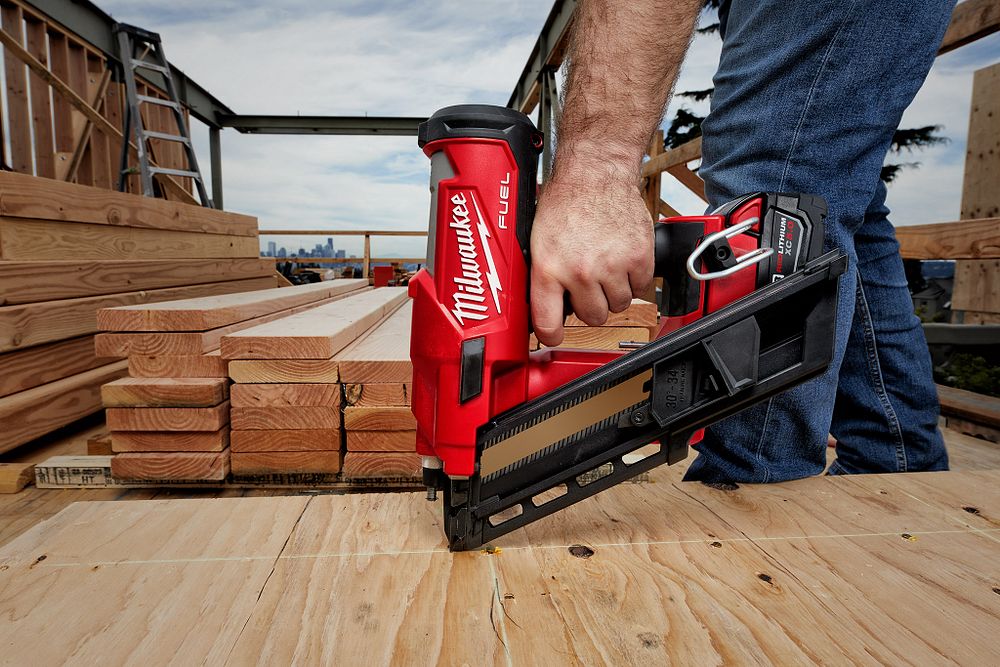
Framing nailers handle the heavy work: wall plates, headers, roof rafters, floor joists, and engineered lumber. You need a tool that can sink a full-round-head nail into LVL and dense engineered wood without bouncing or double-driving. Milwaukee makes two M18 FUEL framing nailers, one in 21 degrees and one in 30 degrees, and both fire 3 nails per second with zero ramp-up time.
The difference between 21 degrees and 30 degrees comes down to nail collation angle and head style, and that determines what your jurisdiction allows and what nail strips you'll be buying.
21 Degree vs. 30 Degree: Which One Do You Need?
The 21-degree framing nailer uses plastic collated full round head nails. Full round head nails are required by code in many jurisdictions, especially in high-wind and seismic zones. If your inspector calls for full round head nails, the 21-degree is your tool.
The 30-degree framing nailer accepts paper collated nails in both clipped head and full round offset head styles. Paper collation means the magazine holds more nails in a tighter package, and the steeper angle makes it easier to work in tight corners where a 21-degree magazine would be awkward. If your area allows clipped head nails and you want a more maneuverable tool, the 30-degree is the better fit.
Check your local building code before you decide.
Milwaukee Framing Nailer Models

Model |
Description |
Nail Angle |
Head Style |
M18 FUEL 21 Degree Framing Nailer, Bare Tool |
21 degrees |
Full round head |
|
M18 FUEL 21 Degree Framing Nailer Kit |
21 degrees |
Full round head |
|
M18 FUEL 30 Degree Framing Nailer, Bare Tool |
30-34 degrees |
Clipped & full round offset |
|
M18 FUEL 30 Degree Framing Nailer Kit |
30-34 degrees |
Clipped & full round offset |
|
21 Degree Extended Capacity Magazine |
Accessory |
For 2744-20 / 2744-21 |
|
30 Degree Extended Capacity Magazine |
Accessory |
For 2745-20 / 2745-21 |
Both the 2744-20 and 2745-20 are bare tools, meaning no battery or charger is included. If you're already running M18 tools on your crew, bare tools are the smarter buy. The kit versions (2744-21 and 2745-21) include a battery and charger, which makes sense if you're building your M18 system from scratch.
The extended capacity magazines (48-08-2744 and 48-08-2745) are worth adding if you're doing high-volume framing and don't want to stop for reloads as often. They're sold separately and are specific to their respective nailer models, so make sure you're matching the right magazine to the right tool.
Both framing nailers accept nails from 2 inches to 3-1/2 inches in length and drive into dense engineered lumber without flinching. On standard 2x framing, you'll have no issues. On LVL headers and engineered lumber that's harder than typical dimensional wood, these tools still perform the way you'd expect from a pneumatic gun.
Milwaukee Brad Nailers
Brad nailers use 18 gauge nails, which are thinner than finish nails and leave smaller holes. That makes them the right call for light trim, cabinet face frames, small moldings, furniture assembly, and anywhere you want minimal surface damage that's easy to fill or doesn't need filling at all.
Milwaukee makes one M18 FUEL 18 gauge brad nailer and one M12 FUEL 18 gauge compact brad nailer. The difference between them is size and battery platform, not performance.
Milwaukee Brad Nailer Models

Model |
Description |
Platform |
Nail Range |
M18 FUEL 18 Gauge Brad Nailer, Bare Tool |
M18 |
5/8" to 2" |
|
M18 FUEL 18 Gauge Brad Nailer Kit |
M18 |
5/8" to 2" |
|
M12 FUEL 18 Gauge Compact Brad Nailer, Bare Tool |
M12 |
5/8" to 1-1/2" |
The M18 FUEL Brad Nailer (2746-20) is the standard choice for a crew running M18 batteries. It fires clean consistent nail holes with zero ramp-up time and handles everything from cabinet installs to light trim work. Paired with an M18 CP2.0 battery, it delivers clean performance throughout the charge.
The M12 FUEL Compact Brad Nailer (2541-20) is worth looking at if you're doing trim work in tight spaces or you're already running M12 tools. At only 4.6 pounds with an M12 CP2.0 battery, it's the lightest cordless brad nailer in its class. It only drives nails up to 1-1/2 inches compared to 2 inches on the M18 version, so keep that in mind if you're doing thicker material work. Paired with an M12 CP2.0 battery, it fires over 700 nails per charge.
If you're doing cabinetry, furniture work, or precision trim where every extra ounce matters at the end of a long day, the M12 version is hard to beat. If you want the full nail range and you're on M18, go with the 2746-20.
Milwaukee Finish Nailers

Finish nailers drive thicker, stronger nails than brad nailers and leave a countersunk head that you can fill and paint over. They're the go-to for baseboards, crown molding, door casings, window trim, stair treads, and anywhere structural holding power matters more than a tiny nail hole.
Milwaukee has three finish nailers: a 15 gauge and two 16 gauge options. The gauge tells you the nail thickness, and that determines both the holding power and the size of the hole left behind.
15 Gauge vs. 16 Gauge: What's the Difference?
15 gauge nails are thicker and stronger. They hold better in heavy trim applications like thick baseboards, large crown molding, and stair treads. The tradeoff is a slightly larger nail hole that requires more filler to hide.
16 gauge nails are thinner, leave a smaller hole, and are easier to hide with minimal filling. They're the right choice for lighter trim work, cabinet molding, and anywhere you want a cleaner finish with less fill work. Within 16 gauge, you've got two choices: angled and straight. The angled finish nailer gets into tighter corners more easily. The straight version has a more compact nose that works better in some close-quarter situations depending on your angle of approach.
Milwaukee Finish Nailer Models

Model |
Description |
Gauge |
Nails Per Charge |
M18 FUEL 15 Gauge Finish Nailer, Bare Tool |
15 gauge |
Up to 750 |
|
M18 FUEL 15 Gauge Finish Nailer Kit |
15 gauge |
Up to 750 |
|
M18 FUEL 16 Gauge Angled Finish Nailer, Bare Tool |
16 gauge angled |
Up to 800 |
|
M18 FUEL 16 Gauge Angled Finish Nailer Kit |
16 gauge angled |
Up to 800 |
|
M18 FUEL 16 Gauge Straight Finish Nailer |
16 gauge straight |
Up to 700 |
The M18 FUEL 15 Gauge Finish Nailer (2839-20) is built for the heaviest finish work. If you're installing thick hardwood baseboard, large crown, or structural trim that needs to hold without movement, this is the tool. It fires up to 750 nails per charge paired with a CP2.0 battery.
The M18 FUEL 16 Gauge Angled Finish Nailer (2841-20) is probably the most versatile finish nailer in the lineup. The angled magazine lets you get into tight inside corners that a straight nailer can't reach without repositioning. It fires up to 800 nails per charge with a CP2.0 battery. If you're doing a lot of trim work and you want one tool that handles most situations, this is it.
The M18 FUEL 16 Gauge Straight Finish Nailer (3020-20) is a solid choice when the angled head would get in the way. Some carpenters prefer the straight style for flat trim runs where they're not dealing with inside corners. It fires up to 700 nails per charge.
All three finish nailers use the same nitrogen air spring system as the rest of Milwaukee's cordless nailer lineup. You get consistent nail depth in both hard and soft woods, clean holes that are easy to fill, and zero ramp-up time between shots.
All three finish nailers use the same nitrogen air spring system as the rest of Milwaukee’s cordless nailer lineup. You get consistent nail depth in both hard and soft woods, clean holes that are easy to fill, and zeo ramp-up time between shots.
Milwaukee Coil Roofing Nailer

Roofing nailers are a completely different animal from the rest of the nailer lineup. You're driving a high volume of nails fast, you're working on a roof, and you don't want to drag an air compressor and hose up there if you can avoid it. The Milwaukee M18 FUEL Coil Roofing Nailer is built for exactly that.
Milwaukee Coil Roofing Nailer Models
Model |
Description |
Platform |
M18 FUEL Coil Roofing Nailer, Bare Tool |
M18 |
|
M18 FUEL Coil Roofing Nailer Kit |
M18 |
The 2909-20 is the bare tool version for crews already on M18. The 2909-21 kit includes a battery and charger for anyone setting up a new system.
The coil magazine holds significantly more nails than a stick magazine framing nailer, which means fewer reloads on a long roof run. Roofing coils are collated differently than framing nails, and this tool is designed specifically for that format.
If you're a roofer who's been tied to an air compressor and hose on every job, the M18 FUEL coil roofing nailer lets you work without any of that. You're carrying battery weight instead of dragging hose weight, and on a steep pitch where moving around is already tricky, that matters.
Milwaukee Pin Nailers

Pin nailers use 23 gauge headless pin nails, which are so thin they're essentially invisible once driven. They don't hold much weight on their own, but that's not the point. Pin nailers are used with glue for bonding delicate trim and molding, and the pin just holds the piece in place while the glue sets. No visible nail hole, no filler required.
This is the tool for cabinet face frames, thin veneer work, lightweight decorative molding, and anywhere a visible nail hole would ruin the finish.
Milwaukee Pin Nailer Models
Model |
Description |
Platform |
Nails Per Charge |
M12 23 Gauge Pin Nailer, Bare Tool |
M12 |
Up to 750 |
|
M12 23 Gauge Pin Nailer Kit |
M12 |
Up to 750 |
The M12 23 Gauge Pin Nailer (2540-20) is Milwaukee's most compact cordless pin nailer. It runs on the M12 platform, which keeps it light and easy to handle in the tight spaces where you'd typically need a pin nailer. The nitrogen air spring mechanism drives headless pin nails from 1/2 inch to 1-3/8 inches consistently into both hard and soft materials.
It features a double-action trigger for sequential driving and a non-marring precision point tip for accurate pin placement on delicate trim. The dry-fire lockout prevents misfires and protects the workpiece. Paired with an M12 CP1.5 battery, you get up to 750 pin nails per charge.
The 2540-21 kit version includes a battery and charger. If you're adding pin nailing to an existing M12 setup, the bare tool is the better value.
Milwaukee Palm Nailer

The palm nailer is in a category of its own. It doesn't have a magazine or a trigger in the usual way. Instead, you hold it in your palm and it uses rapid impacts to drive individual nails that you feed by hand. That sounds slower, but it's the right tool for nailing in spaces where no regular nailer can fit.
Joist hanger nails, hurricane ties, post caps, structural connectors. All of those tight metal connector applications where you need to drive nails at awkward angles in confined spaces are where this tool earns its place.
Milwaukee Palm Nailer Models
Model |
Description |
Platform |
Nail Range |
M12 Palm Nailer, Bare Tool |
M12 |
6d to 16d (framing nails) |
|
M12 Palm Nailer Kit |
M12 |
6d to 16d (framing nails) |
The M12 Palm Nailer (2458-20) delivers 2.2 ft-lbs of blow energy and uses an industrial magnetic collet that holds framing nails securely for one-handed use. You're not trying to hold the nail with your fingers in an awkward position. The magnet holds it so you can focus on placement and driving.
The all-metal gear housing is built for the jobsite conditions you'd expect when you're wedged into a floor joist bay or driving hurricane tie nails at an awkward angle. There's an LED work light and a hand strap for control. It runs on the M12 platform and is compatible with all M12 REDLITHIUM batteries.
The 2458-21 kit includes the nailer, an M12 REDLITHIUM battery, a 30-minute charger, and a tool bag. If you're already on M12, the bare tool is the buy.
Which Milwaukee Nailer Is Right for Your Job?
Here's a quick reference to help you match the tool to the application:
Application |
Right Tool |
Model |
Wall framing, headers, rafters, engineered lumber |
21 Degree Framing Nailer |
2744-20 / 2744-21 |
Framing where clipped heads are allowed, tight corner framing |
30 Degree Framing Nailer |
2745-20 / 2745-21 |
Light trim, cabinet faces, small moldings, furniture |
M18 FUEL 18 Gauge Brad Nailer |
2746-20 / 2746-21CT |
Light trim in tight spaces, M12 platform users |
M12 FUEL 18 Gauge Compact Brad Nailer |
2541-20 |
Heavy baseboard, large crown molding, stair treads |
M18 FUEL 15 Gauge Finish Nailer |
2839-20 / 2839-21CT |
Trim work with inside corners, general finish carpentry |
M18 FUEL 16 Gauge Angled Finish Nailer |
2841-20 / 2841-21CT |
Flat trim runs, general finish work |
M18 FUEL 16 Gauge Straight Finish Nailer |
3020-20 |
Roofing, shingles, high-volume fastening on roofs |
M18 FUEL Coil Roofing Nailer |
2909-20 / 2909-21 |
Delicate trim, veneer, glue-assisted bonding (no visible holes) |
M12 23 Gauge Pin Nailer |
2540-20 / 2540-21 |
Structural connectors, joist hangers, tight-space nailing |
M12 Palm Nailer |
2458-20 / 2458-21 |
Bare Tool or Kit: Which Should You Buy?
If you're already running M18 or M12 batteries, buy the bare tool. You're not getting any extra value from a kit battery when you've already got batteries charged and ready. The bare tool versions are priced lower and let you put that savings toward another tool or accessory.
If you're new to Milwaukee or adding your first nailer to a system you're just starting, the kit makes more sense. You get the battery, the charger, and the tool in one purchase, and the kit pricing is usually better than buying each piece separately.
One thing to keep in mind: the M18 nailers and M12 nailers use different batteries. You can't run an M18 battery in an M12 tool or vice versa. If your crew runs both platforms, you'll want to track which batteries go with which tools. Within each platform, any REDLITHIUM battery works. A higher Ah battery just gives you more nails per charge.
Frequently Asked Questions
What's the difference between a 21 degree and 30 degree framing nailer?
The degree refers to the collation angle of the nail strip. 21 degree framing nailers use plastic collated full round head nails. 30 degree nailers use paper collated nails in clipped head or full round offset head styles. Some building codes require full round head nails, which means you'd need the 21 degree. Check your local code before you buy. If your area allows clipped heads, the 30 degree is a good choice because it's easier to maneuver in tight corners.
Can I use the same M18 battery in all M18 nailers?
Yes. All M18 REDLITHIUM batteries are compatible with all M18 nailers. A higher Ah battery, like an XC5.0 or HD12.0, gives you more nails per charge than a CP2.0. The CP2.0 is lighter and still gets the job done for most applications. You won't hurt the tool by using any M18 battery. You'll just get longer or shorter runtime depending on capacity.
What is a palm nailer used for?
A palm nailer drives individual nails one at a time using rapid impacts. It's not a magazine-fed nail gun. You load one nail at a time. The reason you'd reach for it is when you're driving nails in spaces that no regular nailer can access, like joist hanger bays, hurricane tie connector plates, and tight framing corners. If you do structural connector work, a palm nailer is a tool you'll use regularly.
What's the difference between 15 gauge and 16 gauge finish nailers?
15 gauge nails are thicker and provide more holding power. They're better for heavy trim like large baseboards and crown molding where strength matters. 16 gauge nails are thinner and leave a smaller hole that's easier to conceal. For most finish work, 16 gauge is the right call. Go with 15 gauge when you need maximum holding power on heavy or structural trim.
What's a pin nailer used for?
Pin nailers drive 23 gauge headless nails that are nearly invisible once driven. They're used with wood glue to hold lightweight trim and molding in place while the glue sets. You wouldn't use a pin nailer for structural connections. It doesn't have the holding power. But for cabinet face frames, thin veneer, and delicate decorative molding, a pin nailer is the cleanest option because it leaves no visible hole to fill.