


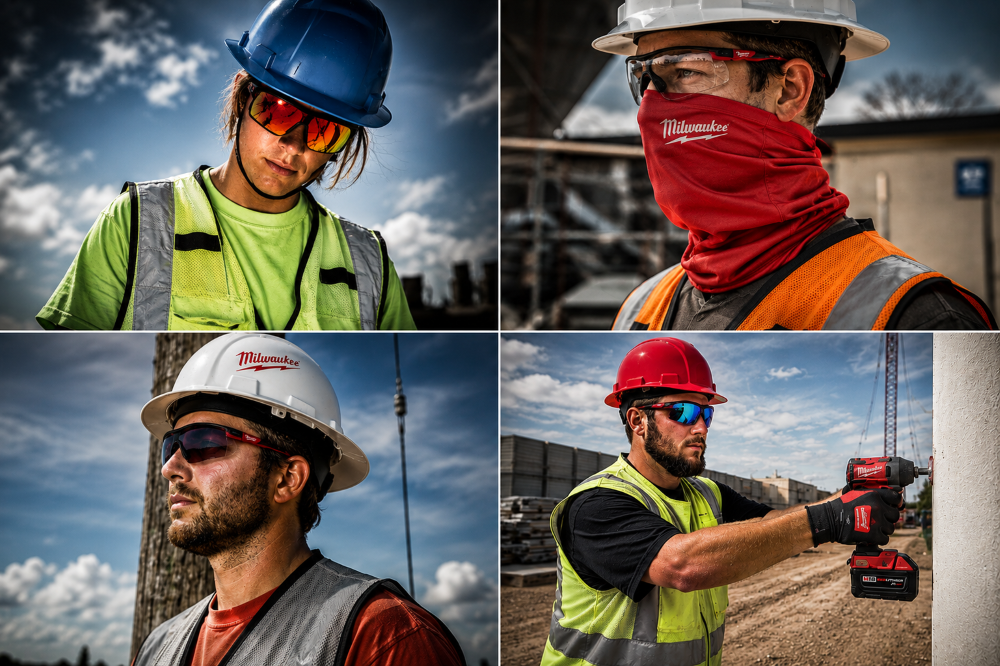
Milwaukee Tool makes safety glasses across a full spectrum of lens types, each designed for specific conditions. This guide breaks them all down to keep your eyes safe, depending on your needs and jobsite hazards.
All Milwaukee safety glasses covered in this guide meet ANSI Z87.1 safety standards, which is the baseline requirement for impact-rated eye protection on most job sites.
Why Lens Type Matters More Than You Think

A lot of the time, jobsite professionals grab whatever safety glasses are in the tool bag and move on. But that doesn't always work as hazards are always changing when it comes to construction work. Lens type is the single most important variable in safety glasses performance.
For outdoor summer work specifically, the light conditions on a job site change fast. You might start a morning under shade cover, move into direct sun trimming at a property edge, and then duck back inside to pull wire in a dim utility room. The wrong lens type costs you visibility and comfort in all of these situations.
Here's what to know about each lens category before you pick a pair.
- Tinted lenses: Reduce total light transmission. Best for outdoor sun exposure, bright open job sites, roofing, and landscaping work in direct sunlight.
- Gray lenses: Similar function to tinted but with neutral color rendering. Best for high-glare conditions and all-day outdoor work where accurate color perception matters.
- Fog-free lenses: Anti-fog coating prevents condensation in humid, confined, or temperature-change environments. Best for HVAC work, wearing a mask, crawl spaces, and moving between hot exteriors and cool interiors.
- Polarized lenses: Reduce horizontal glare reflected from flat surfaces like water, concrete, and asphalt. Best for waterfront work, flatwork concrete, and open sun conditions with reflective surfaces.
- Transition lenses: Automatically darken outdoors and lighten indoors. Best for crews and supervisors moving between environments throughout the day.
Clear Lens Milwaukee Safety Glasses

Clear lenses are the standard for indoor trade work. They transmit the maximum amount of available light, which makes them the right choice for dim mechanical rooms, panel work inside structures, carpentry indoors, and any application where you need to see clearly without tinting the available light. Clear lenses are the standard for indoor trade work. They transmit the maximum amount of available light, which makes them the right choice for dim mechanical rooms, panel work inside structures, carpentry indoors, and any application where you need to see clearly without tinting the available light.
Clear lenses are also the right pick for dawn and dusk work when light is limited, and for any outdoor work happening in overcast conditions without direct sun. Running a clear lens in full midday sun will cause fatigue faster than a tinted lens.
Milwaukee offers three clear lens options: the 48-73-2000 standard clear, the 48-73-2010 clear with anti-scratch coating, and the 48-73-2011 clear with anti-scratch coating. Anti-scratch coating extends lens life on job sites where glasses get set down on rough surfaces or picked up with work gloves. For trade crews, the coated versions are worth the marginal difference for everyday use.
|
Model |
Lens Type |
Coating |
Best Environment |
Best Trade Use |
|
48-73-2000 |
Clear |
Standard |
Indoor, low-light, dawn/dusk |
Electricians, carpenters, indoor general trade |
|
48-73-2010 |
Clear |
Anti-Scratch |
Indoor, workshop, low light |
Mechanics, fabricators, general indoor trade |
|
48-73-2011 |
Clear |
Anti-Scratch |
Indoor, dawn, dusk, overcast |
Electricians, plumbers, HVAC, general trade |
Tinted and Gray Lens Milwaukee Safety Glasses

This is the category most relevant to summer outdoor work. If your crew is working in direct sunlight from May through September, tinted or gray Milwaukee safety glasses are the right standard lens for the job.
Tinted lenses cut down total light entering the eye, reducing squinting and eye fatigue on bright open job sites. They're practical for roofers, landscapers, concrete crews, framing crews, and anyone working in full sun for extended periods. A good pair of Milwaukee tinted safety glasses is one of the simplest ways to reduce eye fatigue on a long summer day.
Gray lenses do the same job with one advantage: they render colors more neutrally than standard brown-tinted lenses. For tradespeople who need accurate color reading on the job, such as electricians color-matching wires outdoors, or concrete crews evaluating pour color, gray lenses are the better option. The 48-73-2106 gray anti-scratch glasses are well-suited for all-day outdoor work.
|
Model |
Lens Type |
Coating |
Best Environment |
Best Trade Use |
|
48-73-2016 |
Tinted |
Anti-Scratch |
Outdoor, bright sun, open sites |
Roofers, landscapers, concrete, framing crews |
|
48-73-2106 |
Gray |
Anti-Scratch |
Outdoor, sun, high glare |
Roofers, concrete, paving, outdoor all-day work |
Fog-Free Milwaukee Safety Glasses

Fogging safety glasses are a safety problem, not just an inconvenience. When a lens fogs up in a crawl space, a mechanical room, or on a humid summer morning, the instinct is to pull the glasses off to see, which eliminates the protection they're supposed to provide.
Milwaukee fog-free safety glasses use an anti-fog coating on the lens to prevent condensation from forming. This is especially relevant for HVAC technicians who constantly move between hot attics and cool living spaces, plumbers working in humid crawl spaces, and anyone wearing a face mask who deals with breath-driven condensation on their lenses.
The 48-73-2013 is a clear fog-free lens, best for indoor humid work and confined spaces. The 48-73-2018 is a tinted fog-free lens, which is the right pick for trades workers doing outdoor work in heat and humidity who also move indoors frequently. The tinted fog-free lens covers both the sun protection and the fogging problem in one pair.
|
Model |
Lens Type |
Coating |
Best Environment |
Best Trade Use |
| 48-73-2013 |
Clear |
Fog-Free |
Confined spaces, humid, masked work |
HVAC, plumbers, pipefitters, mask wearers |
|
48-73-2018 |
Tinted |
Fog-Free |
Hot outdoor work, moving inside/outside |
Landscapers, roofers, outdoor HVAC, site supervisors |
High Performance and Specialty Milwaukee Safety Glasses

Milwaukee's high-performance and specialty eyewear category covers three specific use cases: enhanced outdoor performance, glare reduction on reflective surfaces, and automatic lens adjustment for mixed environments.
Tinted High Performance (48-73-2026)

The 48-73-2026 tinted high performance safety glasses are designed for demanding outdoor environments where debris, dust, and intense sun are all factors. The high performance build provides more robust protection than standard tinted glasses, making them a good choice for grinding work, roofing, concrete breaking, and heavy outdoor trades where particles are present alongside sunlight.
Polarized with Gasket (48-73-2046)

The 48-73-2046 polarized safety glasses with gasket are the specialty outdoor option for workers dealing with reflected glare. Polarized lenses filter horizontal light waves, which are the main component of glare reflected off water, wet concrete, asphalt, and other flat reflective surfaces. The gasket seal around the lens blocks peripheral light and debris entry, making these a full-coverage outdoor lens. For marine workers, concrete flatwork crews, asphalt paving crews, and anyone working in open sun conditions with highly reflective surfaces, the polarized gasket model is the most capable Milwaukee safety glasses option for those conditions.
Transition Performance (48-73-2128)

The 48-73-2128 transition performance safety glasses automatically darken when exposed to UV light outdoors and lighten when you go back inside. This makes them the most versatile single pair in the Milwaukee safety glasses lineup for crews that move between environments constantly throughout the day. Site supervisors walking from a bright exterior to an interior space a dozen times a day don't have to switch glasses. Inspectors, general contractors, and trades leads who spend time both inside and outside on the same properties will get the most value from the transition lens.
|
Model |
Lens Type |
Coating |
Best Environment |
Best Trade Use |
|
48-73-2026 |
Tinted High Performance |
Anti-Scratch |
Bright outdoor, high-debris environments |
Roofers, concrete, grinding, outdoor high-intensity work |
|
48-73-2046 |
Polarized |
Gasket seal |
Waterfront, reflective surfaces, open sun |
Marine, concrete flatwork, asphalt paving, outdoor all-day |
|
48-73-2128 |
Transition |
Anti-Scratch |
Mixed indoor/outdoor environments |
Supervisors, inspectors, crews moving between environments |
Milwaukee BOLT Eye Visors for Hard Hat Users

Standard safety glasses and hard hats don't always work well together. Temples on glasses can break a hard hat seal, glasses can get knocked off when a helmet shifts, and pulling safety glasses on and off throughout the day on a hard hat site is time-consuming. Milwaukee's BOLT Eye Visor system solves this.
BOLT Eye Visors mount directly to Milwaukee BOLT and REDLINE safety helmets using the helmet's visor attachment system. They flip up and down without removing the helmet, they provide full-width coverage across the face, and they're available in clear, tinted, and mirrored dual-coat lens options to match the work environment.
The dual-coat lens on all three BOLT visor models provides both anti-scratch and anti-fog performance, which makes sense for a tool worn integrated with a helmet through varied work conditions.
The 48-73-1410 clear dual coat visor works for indoor and low-light outdoor work. The 48-73-1416 tinted dual coat visor is the outdoor sun option for roofing, structural work, and site supervision in full sun. The 48-73-1419 mirrored dual coat visor handles high-glare outdoor conditions with the highest level of sun protection in the BOLT lineup.
It's worth noting that BOLT Eye Visors are not standalone safety glasses. They require a compatible Milwaukee helmet and are a different product category from the standard safety glasses covered in the rest of this guide.
|
Model |
Lens Type |
Coating |
Compatible Helmets |
Best Use |
|
48-73-1410 |
Clear |
Dual Coat |
Milwaukee BOLT and REDLINE safety helmets |
Indoor, low light, overhead work, welding prep areas |
|
48-73-1416 |
Tinted |
Dual Coat |
Milwaukee BOLT and REDLINE safety helmets |
Outdoor jobsite work, roofing, bright sun with hard hat required |
|
48-73-1419 |
Mirrored |
Dual Coat |
Milwaukee BOLT and REDLINE safety helmets |
High-glare outdoor work, open sun, water-facing or concrete-facing tasks |
Which Milwaukee Safety Glasses Are Right for Your Trade?

Here's a trade-by-trade guide to picking the right Milwaukee safety glasses for your work conditions.
Electricians
Most electrical work happens indoors or in partially lit spaces. Clear anti-scratch lenses are the standard: the 48-73-2010 or 48-73-2011 are solid daily picks. For electricians pulling wire in humid mechanical rooms or attics, the 48-73-2013 clear fog-free lens prevents the fogging that comes with confined, humid spaces. Electricians who split time between indoor rough-in and outdoor service work may find the 48-73-2128 transition lens worth considering.
Roofers
Roofers work in direct sun on reflective surfaces all day. Tinted anti-scratch glasses are the baseline: the 48-73-2016 handles most conditions well. For high-glare days on light-colored roofing materials, the 48-73-2106 gray anti-scratch or the 48-73-2026 high performance tinted are better picks. Roofers wearing helmets should look at the 48-73-1416 or 48-73-1419 BOLT visor options for helmet-integrated eye protection.
Landscapers
Landscapers work outdoors in mixed conditions: sun, dust, debris, and humidity all come into play. The 48-73-2018 tinted fog-free glasses cover the most bases, handling outdoor sun while resisting the fogging that comes from humidity and moving in and out of enclosed areas. For pure sun days, the 48-73-2016 or 48-73-2106 are practical options.
HVAC Technicians
HVAC work means constant transitions between attics, crawl spaces, exterior units, and conditioned interior spaces. Temperature shifts and humidity are a daily reality. The 48-73-2013 clear fog-free and the 48-73-2018 tinted fog-free are the two most relevant Milwaukee safety glasses for HVAC work. The fog-free coating handles the condensation that hits lenses every time you move from a hot space to a cooled one. Technicians doing a mix of interior and exterior work often find the tinted fog-free more versatile.
Mechanics and Auto Techs
Shop work and roadside work have different lens needs. For indoor shop use, clear anti-scratch lenses are standard: the 48-73-2010 or 48-73-2011 work well. Mobile and roadside mechanics working outdoors need tinted options. The 48-73-2016 tinted anti-scratch handles most outdoor conditions. For mechanics who work in humid shops or deal with exhaust and steam, the 48-73-2013 clear fog-free lens keeps vision clear.
Concrete and Flatwork Crews
Wet concrete is one of the most reflective surfaces workers face in direct sun. Gray or polarized lenses make a noticeable difference for flatwork crews. The 48-73-2106 gray anti-scratch is a practical daily lens. For crews doing flatwork in open sun next to water or on highly reflective surfaces, the 48-73-2046 polarized with gasket provides the highest glare reduction in the Milwaukee safety glasses lineup.
Which Set of Milwaukee Safety Glasses is Right For You?
The right pair of Milwaukee safety glasses is the one matched to where you actually work and what conditions you face. Clear anti-scratch glasses for the electrician on interior rough-in, tinted fog-free for the HVAC tech moving between attics and conditioned spaces, polarized with gasket for the concrete crew in full sun on a reflective deck, and BOLT visors for the site supervisor running a Milwaukee-helmeted crew. Every model covered in this guide meets ANSI Z87.1 standards.
Whether you're stocking a single pair for yourself or outfitting a full crew, browse the complete Milwaukee safety glasses lineup including the 48-73-2000, 48-73-2011, 48-73-2016, 48-73-2106, 48-73-2013, 48-73-2018, 48-73-2026, 48-73-2046, 48-73-2128, and the BOLT visors 48-73-1410, 48-73-1416, and 48-73-1419 and more.
Frequently Asked Questions: Milwaukee Safety Glasses
What's the difference between Milwaukee fog-free and anti-scratch safety glasses?
Milwaukee fog-free safety glasses have a lens coating specifically designed to prevent condensation from forming on the lens in humid, confined, or temperature-changing environments. Anti-scratch safety glasses have a coating that protects the lens surface from scratching under normal job site use. Some Milwaukee safety glasses models, such as the 48-73-2011, include an anti-scratch coating on a clear lens, while fog-free models like the 48-73-2013 and 48-73-2018 prioritize the anti-fog coating for humid or temperature-variable work environments. The two coatings address different problems: fogging versus surface wear.
Are Milwaukee safety glasses ANSI rated?
Yes, Milwaukee safety glasses meet ANSI Z87.1 safety standards. ANSI Z87.1 is the American National Standards Institute standard for impact-rated eye protection, covering high-velocity impact resistance, lens retention, and optical clarity requirements. All standard Milwaukee safety glasses models referenced in this guide carry this rating, making them appropriate for OSHA-compliant eye protection use on commercial and industrial job sites.
What Milwaukee safety glasses are best for outdoor summer work?
The best Milwaukee safety glasses for outdoor summer work are tinted or gray lens models for full-sun conditions. The 48-73-2016 tinted anti-scratch and the 48-73-2106 gray anti-scratch are the standard outdoor picks. For crews dealing with high glare from reflective surfaces like wet concrete or asphalt, the 48-73-2046 polarized high performance safety glasses with gasket provide the highest glare reduction. For workers who move between outdoor sun and indoor spaces throughout the day, the 48-73-2128 transition performance safety glasses automatically adjust lens tint and eliminate the need to switch pairs.
Do Milwaukee transition safety glasses work for both indoor and outdoor use?
Yes, the Milwaukee 48-73-2128 transition performance safety glasses are designed specifically for both indoor and outdoor use. The transition lens automatically darkens when exposed to UV light outdoors and clears when you move indoors away from UV exposure. This makes them a practical single-pair solution for trades workers and supervisors who move between outdoor sun and interior work spaces frequently during the day. The 48-73-2128 also includes an anti-scratch lens coating for job site durability.
Can I use Milwaukee safety glasses with a hard hat?
Standard Milwaukee safety glasses can be worn with a hard hat in most cases, though temples on standard glasses can conflict with a hard hat suspension system depending on the helmet model. Milwaukee offers BOLT Eye Visors (48-73-1410, 48-73-1416, and 48-73-1419) specifically for use with Milwaukee BOLT and REDLINE safety helmets. BOLT Eye Visors mount directly to the helmet and flip up and down without removing the hard hat, providing a more integrated and stable eye protection solution for hard hat users than wearing standard safety glasses underneath a helmet.