


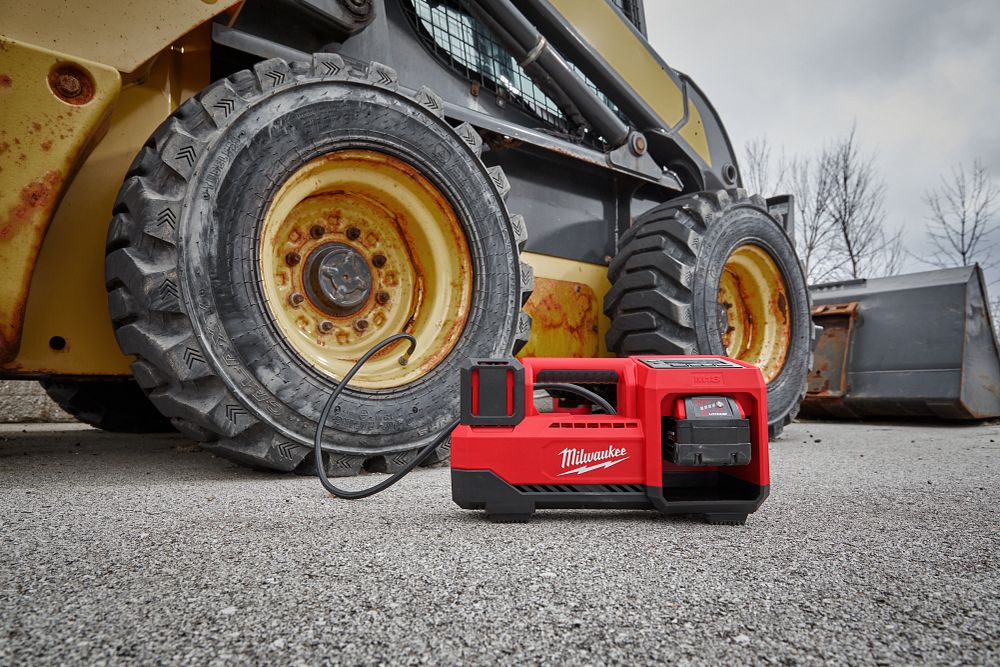
Whether you're a mechanic dealing with a customer's vehicle in the bay, a contractor whose crew truck is sitting low in the parking lot before a job, or a landscaping operation with a zero-turn that won't roll until you pump up a tire, downtime can add up fast. The Milwaukee cordless tire inflator gives you the speed and portability to handle inflation on the spot, without hunting for an outlet, dragging a compressor outside, or waiting on a service call.
Milwaukee makes two cordless inflators, the M18 and the M12, and each one fits a specific set of trade needs. This guide breaks down how both models work, what PSI ratings mean for real-world applications, and which Milwaukee inflator belongs in your truck, shop, or tool bag.
Why Cordless Beats a Compressor for On-the-Go Inflation

A shop compressor is great when you're parked next to one. But trades work doesn't always happen next to a compressor. Fleet vehicles, job site trucks, landscaping equipment, and contractor vans get flat tires in parking lots, on roadsides, at customer sites, and in the middle of a field. In those situations, a cordless tire inflator on your M18 or M12 battery does the job instantly.
Cordless inflators also work well for quick top-offs before a route or first thing in the morning. Instead of rolling a compressor out of the shop or waiting for a large tank to build pressure, you pull the inflator off the charger, set your PSI, and go. The Milwaukee tire inflator handles the same basic inflation tasks as a bench compressor for most vehicle tire jobs, and it does it without the noise, the cords, or the setup time.
For mechanics who do roadside work or run a mobile service, the Milwaukee M18 inflator is especially practical. It runs on the same M18 battery as your impact wrenches, drills, and lights, so you're already carrying the power source.
M12 vs. M18: Which Milwaukee Inflator Do You Need?

Milwaukee makes two inflator platforms, and the right choice depends on what you're inflating and how often you need to do it. Here's the practical breakdown.
Milwaukee M18 Compact Tire Inflator (2848-20)

The 2848-20 is Milwaukee's full-capability cordless tire inflator. It hits 150 PSI max, which covers nearly every passenger vehicle, truck, van, and light equipment tire you'll run into in a trade setting. It inflates a standard car tire from flat in approximately 3 minutes, it has a built-in digital pressure gauge, and it includes an auto-stop function that shuts off at your preset PSI so you don't have to watch it. It works with Schrader and Presta valves, covering everything from vehicle tires to road bikes. If you're a mechanic, contractor, or fleet manager who needs a capable inflator across multiple vehicle types, the 2848-20 is the right tool.
Milwaukee M12 Compact Inflator (2475-20 and 2475-21XC)

The 2475-20 runs on M12 batteries and maxes out at 120 PSI. It's more compact than the M18 version, making it a good fit for tight spaces and lighter-duty jobs. Car tires, bike tires, sports balls, and air mattresses are all within range. It won't handle high-pressure truck tires as effectively as the M18, but for trades workers whose main need is keeping a service vehicle or personal vehicle tire at the right pressure, it does the job well. The 2475-21XC kit version includes the inflator plus an M12 XC4.0 battery and charger, which is a good option if you're new to the M12 platform.
PSI Explained: What Different Trade Applications Need
Not all tires need the same pressure. Before you pick a Milwaukee inflator, it helps to know what PSI range you're dealing with.
- Passenger cars: typically 32 to 36 PSI. Both the M12 and M18 handle this easily.
- Light trucks and vans: typically 35 to 45 PSI for most use cases. Both models cover this range.
- Heavy-duty truck tires: can range from 65 to 110 PSI or higher for commercial vehicles. The M18 at 150 PSI max handles this range. The M12 at 120 PSI covers most but not the heaviest commercial applications.
- Construction and landscaping equipment tires: varies widely. Skid steer tires often run 60 to 90 PSI. Zero-turn mowers typically run 10 to 18 PSI in the rear and higher in front casters. Both Milwaukee inflators handle these ranges.
- Bike tires: road bike tires can run 80 to 130 PSI. The M18 at 150 PSI handles this fully. The M12 at 120 PSI covers most bike tires but will be near its limit on high-pressure road tires.
- Sports equipment and air mattresses: low PSI, both models work fine.
The key takeaway: if you're running a mixed trade vehicle fleet or working on high-pressure tires regularly, the M18 Milwaukee tire inflator gives you the headroom you need. If your work is mostly passenger vehicles and lighter equipment, the M12 inflator gets the job done with a smaller package.
Milwaukee Tire Inflator Models at a Glance
Model |
Platform |
Max PSI |
Auto-Stop |
Battery |
Best Use |
| 2848-20 |
M18 |
150 PSI |
Yes | M12 |
Car, truck, van, equipment tires; shop and roadside |
|
2475-20 |
M12 |
120 PSI |
Yes | M12 |
Car tires, bike tires, sports equipment, air mattresses |
|
2475-21XC |
M12 |
120 PSI |
Yes |
M12 XC4.0 + charger included |
Car tires, bike tires, sports equipment; kit for new M12 users |
How Mechanics Use the Milwaukee Tire Inflator
Auto techs and mechanics have two main situations where a cordless inflator earns its keep. First is in-shop use, when you need to top off a tire quickly between jobs without walking to the compressor station. Second is roadside or mobile service, when you're working out of a service van and a compressor isn't practical.
For shop use, the 2848-20 M18 inflator is a fast, grab-and-go tool that fits on a workbench or tool cart. You set your target PSI on the digital gauge, connect to the valve stem, and it handles the rest. The auto-stop shuts it off when it hits your number. For mobile mechanics, it means the job doesn't stop because of a tire.
How Contractors Use the Milwaukee Cordless Tire Inflator
Contractors run a lot of miles on truck tires, and fleet vehicle maintenance is part of keeping a crew running on schedule. Flat or low tires on a job site mean lost time, and many contractors don't have compressor access wherever work happens.
A Milwaukee inflator kept in the truck bed or crew van lets the foreman or crew lead handle a flat or low tire without calling for help. Since most contractors are already on M18 batteries, the 2848-20 slots right into the existing battery system without adding another charger or platform to manage.
Landscapers and Equipment Operators
Landscaping fleets deal with tire pressure on mowers, trailers, trucks, and utility vehicles. A tire that's low on a trailer can cause handling issues on a highway run to the next property. A zero-turn with a soft tire tears up turf and handles poorly.
Having a Milwaukee M18 inflator in the crew trailer means a tech can handle pressure checks and top-offs at the start of every day, or fix a slow leak on the fly before loading equipment. The 150 PSI max covers trailer tires, mower tires, and truck tires in one tool.
HVAC and Fleet Managers
HVAC service vans log high mileage and carry heavy equipment loads, both of which accelerate tire wear and pressure loss. Fleet managers who equip vans with a Milwaukee inflator give technicians the ability to correct tire pressure before it becomes a service call or a breakdown.
For fleets already running Milwaukee tools in service vehicles, the inflator is one more M18 tool in a system the crew already knows.
Tips for Using a Digital Tire Inflator Correctly

A digital inflator is only as accurate as how you use it. These tips apply to all Milwaukee inflator models.
- Check cold PSI. Tire pressure should always be measured when tires are cold, meaning the vehicle hasn't been driven for at least three hours or driven less than a mile. Heat from driving raises tire pressure temporarily, which can give you a false reading.
- Use the recommended PSI, not the maximum. The correct tire pressure is on the door jamb sticker on the driver's side door, not on the tire sidewall. The sidewall number is the maximum the tire can hold, not the recommended operating pressure.
- Set the auto-stop before you connect. On the Milwaukee M18 inflator, set your target PSI before you attach the hose to the valve stem. This lets the tool shut off automatically without you standing over it.
- Check the valve stem before connecting. A dirty or damaged valve stem core can cause leaks and inaccurate readings. Wipe it clean before attaching the inflator hose.
- Let the digital gauge settle. After inflating, disconnect and reconnect the gauge briefly to confirm the final PSI reading is stable.
- Store it with the battery removed if it won't be used for extended periods. Milwaukee batteries last longer when stored separately at partial charge in moderate temperatures.
Get the Right Milwaukee Inflator for Your Trade
The Milwaukee tire inflator lineup covers the full range of inflation jobs that come up in daily trade work. Whether you're a mechanic who needs a fast, accurate inflator for the shop and the road, a contractor keeping a fleet of work trucks at the right pressure, or a landscaping crew dealing with mower and trailer tires, Milwaukee has the cordless solution that runs on the battery system you already own. The 2848-20 M18 is the go-to for heavy-duty and mixed-use applications. The 2475-20 M12 and the 2475-21XC kit are the right fit when you want a compact inflator for lighter jobs or want to add an inflator to your M12 setup.
Frequently Asked Questions: Milwaukee Tire Inflator
What is the max PSI of the Milwaukee M18 tire inflator?
The Milwaukee M18 compact tire inflator (model 2848-20) has a maximum PSI of 150. This covers passenger cars, light trucks, vans, most commercial vehicle tires, high-pressure bike tires, and a wide range of construction and landscaping equipment tires.
Can the Milwaukee cordless tire inflator fill a truck tire?
Yes, the Milwaukee M18 tire inflator can fill a truck tire. With a 150 PSI maximum, it handles the typical operating pressure range for light-duty and medium-duty truck tires, which generally run between 35 PSI and 80 PSI depending on load rating. For heavy commercial truck tires that require pressures above 100 PSI, the M18 inflator still provides the capacity to bring a low tire up to correct pressure.
Does the Milwaukee tire inflator auto-stop?
Yes, both the Milwaukee M18 inflator (2848-20) and the Milwaukee M12 inflator (2475-20) include an auto-stop function. You set the target PSI using the digital gauge on the tool, and the inflator shuts off automatically when it reaches that pressure. This prevents overinflation and lets you handle other tasks while the tire fills.
What's the difference between the M12 and M18 Milwaukee inflator?
The main differences are maximum PSI, battery platform, and physical size. The Milwaukee M18 inflator (2848-20) reaches 150 PSI and runs on the M18 battery, making it suited for a wider range of tire types including high-pressure applications. The Milwaukee M12 inflator (2475-20) reaches 120 PSI and runs on the smaller M12 battery, making it more compact and lighter. Both have digital gauges and auto-stop. If you work on trucks, commercial vehicles, or high-pressure bike tires, the M18 is the better choice. If your needs are primarily passenger cars, light equipment, and sports equipment, the M12 handles the job in a smaller package.
How long does it take to inflate a car tire with the Milwaukee M18 inflator?
The Milwaukee M18 compact tire inflator (2848-20) inflates a standard car tire from flat in approximately 3 minutes. Top-off inflation from low pressure, such as adding 10 to 15 PSI to a partially inflated tire, takes significantly less time. Runtime varies based on the starting pressure, target pressure, and battery charge level.