


Table of contents
If you've spent any time on a job site, you know that a reciprocating saw is one of the most useful tools you can have on your belt. From demo work to rough-in cuts to trimming pipe in a tight corner, these saws handle jobs that most other tools can't. Milwaukee makes two distinct lines of cordless reciprocating saws: the Sawzall and the Hackzall. Both cut. Both run on Milwaukee's battery platforms. But they're built for different jobs and different situations.
Before we get into the breakdown, here's a quick look at what's available:
Super Sawzall (M18 FUEL):
Hackzall:
What Is a Sawzall?

The Sawzall is Milwaukee's full-size, two-handed reciprocating saw. Milwaukee invented the reciprocating saw back in 1951 and trademarked the "Sawzall" name. Today, the term "Sawzall" has become so widely used in the trades that most people use it to describe any reciprocating saw, regardless of brand. But the real Milwaukee Sawzall is a specific tool with a specific set of capabilities.
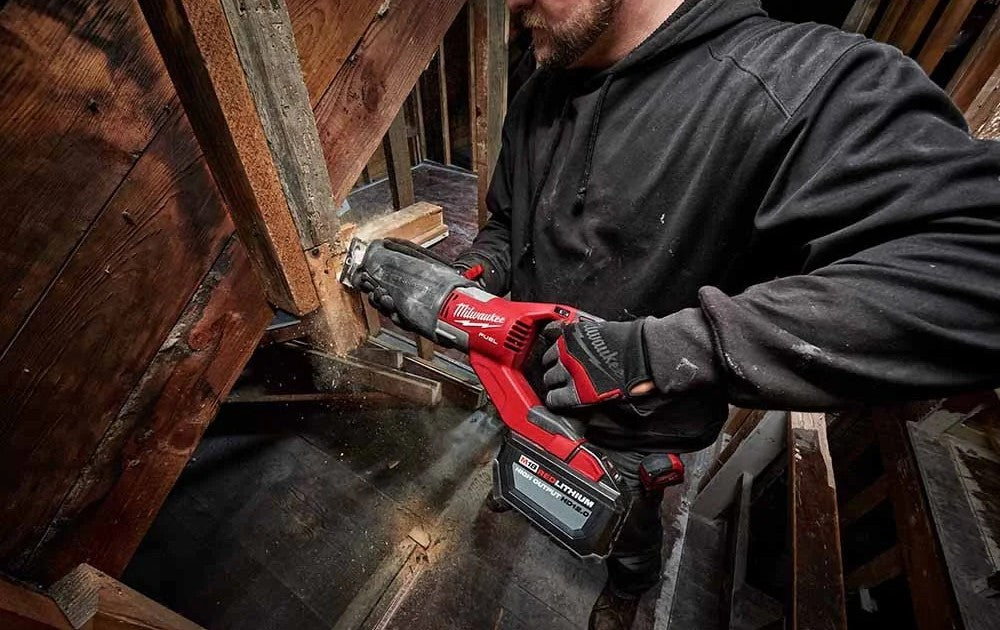
Milwaukee's Sawzall lineup centers on the Milwaukee 2722 M18 FUEL Super Sawzall. It's a two-handed recip saw powered by the M18 platform with Milwaukee's FUEL technology, which means it uses a POWERSTATE brushless motor, REDLINK PLUS electronic intelligence, and is compatible with Milwaukee's REDLITHIUM battery system.
The Super Sawzall is designed for heavy cutting. It handles demolition, structural work, pipe cutting in open areas, cutting through layered materials like walls and floors, and any situation where you need maximum cutting power and a longer stroke. Two-handed operation gives you control and stability when you're working through thick stock or pushing the saw hard.
Key characteristics of the Sawzall:
Two-handed design for heavy-duty cutting
Full-size body with a longer stroke length for aggressive material removal
Higher power output suited to demo and structural cuts
Compatible with the full range of standard reciprocating saw blades
Best for open work areas where you have room to maneuver a full-size saw
What Is a Hackzall?

The Hackzall is Milwaukee's compact, one-handed reciprocating saw. Milwaukee developed the Hackzall specifically for situations where the full-size Sawzall is too big, too heavy, or too awkward to use effectively.
These power tools are designed to be operated with one hand. Its compact body keeps the blade close to your grip, which gives you better visibility and control in tight spaces. It's lighter than the full-size Sawzall, easier to maneuver in overhead positions, and fits into areas where a two-handed saw simply won't go.
Milwaukee's Hackzall lineup covers both the M18 and M12 battery platforms, and includes both FUEL (brushless) and standard (brushed) motor options.
Key characteristics of the Hackzall:
One-handed, compact design
Shorter overall length for use in tight spaces
Available in M12 and M18 platforms
Lighter weight reduces fatigue on long overhead runs or repetitive cuts
Best for HVAC, plumbing rough-in, electrical work, and anywhere space is limited
Breaking Down the Key Differences

Size and Weight
It's the most obvious difference between the two saw families.
The Super Sawzall is a full-size tool. It requires two hands to operate safely and effectively, and it's built to be sturdy. That size and weight is what makes it capable of handling heavy demo and structural cuts. But it also means it's harder to work with in confined spaces, overhead, or in one-handed situations.
The Hackzall is purpose-built to be small and light. You can operate it with one hand, which frees up your other hand to hold material, brace yourself, or position the cut. For trades like HVAC, plumbing, and electrical, where a lot of cuts happen inside walls, above ceilings, or in mechanical rooms with limited room to swing a full-size saw, the Hackzall's compact body is a genuine advantage on the job.
Power and Stroke
The Super Sawzall produces more power and uses a longer stroke length than any of the Hackzall models. A longer stroke means the blade travels further with each cycle, which translates to faster, more aggressive cutting through thick materials. That's why the Super Sawzall is the right tool when you're cutting through dimensional lumber, multiple layers of drywall and stud, cast iron pipe, or any application that demands serious cutting performance.
The Hackzall uses a shorter stroke by design. The compact body requires it. You still get useful cutting capability for the jobs the Hackzall is built to handle, like cutting copper or PVC in a tight mechanical space, trimming conduit flush, or making quick cuts during rough-in work. But the Hackzall is not the right tool when you're trying to push through heavy material fast.
Battery Platform: M12 vs. M18

If you're already running an M18 or M12 battery system, this matters for how the Hackzall fits into your setup.
The Super Sawzall runs exclusively on M18. If you're already on the M18 platform, that's straightforward.
The Hackzall is available on both platforms:
M18 Hackzall options:
2625-20 M18 Hackzall (brushed)
M12 Hackzall options:
2420-20 M12 Hackzall (brushed)
If you're running M12 tools as your primary cordless system, the M12 Hackzall lets you use your existing batteries. For electricians and HVAC techs who already carry M12 tools, this makes a lot of sense. If you're primarily on M18, the M18 Hackzall gives you more runtime and a bit more cutting power compared to the M12 version.
FUEL vs. Standard (Brushless vs. Brushed)
Within the Hackzall lineup, there's another layer to consider: FUEL vs. non-FUEL models.
Milwaukee's FUEL designation means the tool has a POWERSTATE brushless motor, REDLINK PLUS electronics, and works with REDLITHIUM batteries to deliver the best performance across the system. Brushless motors run cooler, have longer motor life, and deliver more consistent power under load compared to brushed motors.
The non-FUEL models (2625-20 M18 and 2420-20 M12) use brushed motors. They cost less and still get the job done for lighter-duty use. But if you're using the Hackzall regularly on the job, the FUEL version will last longer and hold up better under sustained use.
For the Super Sawzall, the 2722 is a FUEL tool. There's no non-FUEL version of the Super Sawzall in this lineup, which makes sense given that the Super Sawzall is designed for demanding work.
The REDLINK PLUS Advantage on FUEL Models
Both the Super Sawzall (2722) and the M18 FUEL Hackzall (2719) use Milwaukee's REDLINK PLUS intelligence system. It's worth understanding because it does more than marketing copy suggests.
REDLINK PLUS is a communication system between the tool, the battery, and the charger. In practice, it means the tool monitors performance in real time and protects against overload, overheating, and over-discharge. If you're pushing the saw hard through heavy material and the motor starts to strain, REDLINK PLUS adjusts output to protect the tool rather than letting it burn out. For contractors running tools hard every day, this type of protection has a real effect on tool lifespan.
Non-FUEL models don't have this system. That doesn't mean they're unreliable for light to moderate use, but it's a meaningful difference if you're buying a tool that needs to last.
Who Should Choose the Super Sawzall?

The M18 FUEL Super Sawzall is the right choice if:
You do demo work regularly. Tearing out walls, cutting out windows, removing old framing, demolishing fixtures. The Super Sawzall is made for this kind of work.
You cut structural lumber, engineered wood, or thick materials frequently. The longer stroke and higher power output make these cuts faster and easier.
You work in open areas where you have room to use both hands.
You're cutting pipe in accessible locations. Cutting cast iron drain lines, large-diameter PVC, or galvanized steel is where a full-size recip saw earns its place.
You need maximum runtime and power on a single charge. The M18 FUEL platform on the Super Sawzall is one of the most capable cordless setups Milwaukee makes.
The Super Sawzall is not the best fit if:
Most of your cuts happen in tight spaces like inside walls, above drop ceilings, or in cramped mechanical rooms.
You need to work one-handed.
You're doing repetitive light cuts where carrying a full-size saw all day adds unnecessary weight and fatigue.
Who Should Choose the Hackzall?
A Hackzall is the right choice if:
You're an HVAC technician cutting in tight mechanical spaces, above ceilings, or around equipment where a full-size saw won't fit.
You're a plumber doing rough-in cuts inside walls or under sinks where access is limited.
You're an electrician making quick cuts to conduit, strut, or fasteners in an electrical panel or tight junction area.
You work overhead frequently. The Hackzall's lighter weight reduces fatigue significantly during overhead cuts compared to a full-size Sawzall.
You're already running the M12 platform and want a recip saw that uses your existing batteries without adding M18 to your setup.
You need a secondary recip saw for trim cuts and light work. Many tradespeople carry both a full-size Sawzall and a Hackzall. The Hackzall handles the quick, tight-space stuff so you're not grabbing the Super Sawzall for every small cut.
The Hackzall is not the best fit if:
You're doing heavy demo work where cutting speed and power through thick material matters.
You're cutting large-diameter pipe, structural lumber, or stacked materials regularly.
You need the saw to handle the most demanding cutting tasks on a job site.
M18 FUEL Hackzall vs. M12 FUEL Hackzall: Which One to Pick

If you've decided the Hackzall is what you need and you're considering FUEL models specifically, here's how to think about M18 vs. M12:
Choose the M18 FUEL Hackzall (2719-20) if:
You're already running M18 tools and want battery compatibility across your tool lineup.
You need a bit more cutting power for moderate-duty cuts in tighter spaces.
You want the most capable Hackzall available.
Choose the M12 FUEL Hackzall (2520-20) if:
You're primarily on the M12 platform. Electricians and HVAC techs in particular often run M12 as their core system.
You want the lightest and most compact Hackzall option.
The cuts you're making don't demand M18-level power.
The M12 FUEL Hackzall is one of the most popular tools in the M12 lineup for a reason. It's compact, it runs on the same batteries as your M12 drill and driver, and for the cuts it's asked to make, it performs extremely well.
A Note on Blade Compatibility
Both the Sawzall and Hackzall accept standard reciprocating saw blades with the universal shank design that Milwaukee and most other blade manufacturers use. Milwaukee's own Sawzall blade lineup covers wood, metal, bi-metal, and demo applications across a wide range of lengths and TPI counts.
The practical difference is that the Hackzall's compact body works best with shorter blades. Shorter blades keep the tool controllable in tight spaces. You can run longer blades in a Hackzall, but you start to lose the advantage of the compact design. For the Super Sawzall, longer blades in the 9" to 12" range are common for demo and pipe cutting.
Making the Right Call for Your Work
The Milwaukee Sawzall and Hackzall solve different problems. They're not competing tools. They're complementary tools built for different parts of the job.
If your work is heavy, open, and demands serious cutting power, the M18 FUEL Super Sawzall is the saw to have. It's one of the most capable cordless recip saws available and it's built to handle the kind of work that beats up tools.
If your work takes you into tight spaces, overhead runs, and one-handed situations, a Hackzall is what gets the job done efficiently. The M18 FUEL and M12 FUEL versions are the ones to reach for if you're using the tool regularly on the job.
A lot of tradespeople end up with both. The Super Sawzall lives in the van for demo and heavy cuts. The Hackzall stays on the belt or in the bag for the quick stuff. Together, they cover almost every reciprocating saw situation you'll run into.
Frequently Asked Questions
What's the difference between a Sawzall and a Hackzall?
The Sawzall is a full-size, two-handed reciprocating saw designed for heavy cutting tasks like demo work, structural cuts, and pipe cutting in open areas. The Hackzall is a compact, one-handed reciprocating saw built for tight spaces, overhead work, and situations where a full-size saw won't fit or is too heavy to use comfortably.
Can a Hackzall do everything a Sawzall can?
No. The Hackzall is not a replacement for the Sawzall. It's designed for a different set of tasks. The Hackzall's shorter stroke and lower power output are intentional trade-offs for compact size and one-handed use. For heavy demo and thick-material cutting, you need the full-size Sawzall.
What does Milwaukee FUEL mean?
FUEL is Milwaukee's designation for tools that combine a POWERSTATE brushless motor, REDLINK PLUS electronic intelligence system, and REDLITHIUM battery compatibility. These three components work together to deliver maximum performance, extended tool life, and protection against overload and overheating.
Can I use my M18 batteries in the M18 Hackzall and the Super Sawzall?
Yes. Both the M18 FUEL Super Sawzall and the M18 FUEL Hackzall run on any M18 REDLITHIUM battery. High-output and XC (extended capacity) batteries will deliver the best performance on demanding cuts.
Is the Super Sawzall good for cutting pipe?
Yes. The Super Sawzall is one of the standard tools for cutting cast iron, galvanized steel, copper, and large-diameter PVC in accessible locations. Pair it with the right blade for the material you're cutting.