


Table of contents
If you've been on the fence about making the switch from gas to battery-powered outdoor equipment, 2026 is a good time to commit. Spring outdoor work is ramping up, and Milwaukee's M18 lineup has recently expanded, giving professionals access to the battery-powered landscaping tools they need for any job or project.
This Milwaukee outdoor power equipment guide will walk through Milwaukee's blowers, chainsaws, mowers, hedge trimmers, and string trimmers to easily determine which fits right for all your landscaping and outdoor needs.
Why Battery-Powered Equipment Makes Sense Right Now

Gas equipment held onto one real advantage for a long time: raw power. But now that advantage is gone. Milwaukee's M18 FUEL 16-inch string trimmer outperforms 31cc gas competitors, and the dual-battery backpack blower delivers more blowing force than up to 60cc gas units. If you're looking to improve performance, Spring 2026 is a good time to consider changing up your lineup.
Regulations are also pushing the shift. California's Air Resources Board has enacted legislation against the purchase of new gas outdoor power equipment, and municipalities across the country are adding noise ordinances that restrict gas blower use by time of day or decibel level. Getting ahead of compliance issues now is a lot easier than scrambling when a city ordinance drops mid-season.
On the system side, Milwaukee's M18 platform maintains full forward and backward compatibility across 275-plus tools. Every battery you buy works across your entire M18 inventory. That means:
- No separate battery systems for different tools
- Blower batteries rotate into your trimmer, chainsaw, and impact wrench
- Kits bought today stay compatible with tools you add later
- Fleet management stays simple when one battery standard covers everything
Milwaukee Blowers

Milwaukee's blower lineup runs from a compact M12 spot blower all the way up to a dual-battery backpack that beats 60cc gas units. Here's how each model fits into a typical operation.
Starting at the compact end, the M12 Compact Spot Blower (0852-20) runs on M12 batteries and is built for quick cleanups in tight areas like truck cabs, equipment compartments, and job trailers. Not a replacement for a full-size blower, but a handy tool to have in the mix.
Stepping up to M18, the M18 Compact Blower (0884-20) is a straightforward handheld that works well for landscape maintenance crews adding blowing capability to an existing M18 battery setup without needing a high-output unit. A solid entry point into the M18 blower range.
Running a brushless motor for better efficiency and longer motor life, the M18 Brushless Handheld Blower (3044-20) is a step above earlier brushed designs and a capable all-around handheld for general site cleanup at the professional level.
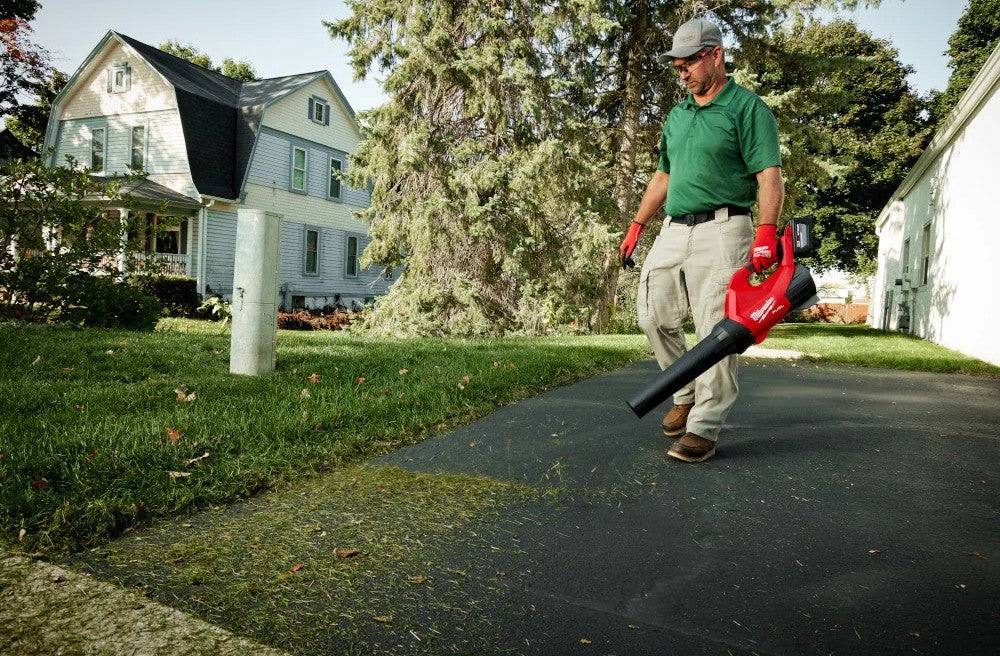
Moving into the FUEL lineup, the M18 FUEL Blower (3017-20 bare tool, 3017-21HD kit) is where output noticeably increases. POWERSTATE brushless motor delivers more airflow and better sustained performance throughout the battery discharge cycle. Pair it with the FORGE HD12.0 battery that comes in the 21HD kit if you want to get through a full day without stopping to charge.
Built for medium to heavy-duty site clearing, the M18 FUEL Dual Battery Blower (2824-20) draws from two M18 packs simultaneously for extended run-time and sustained output. Available as a bare tool and requires two batteries. Good choice for crews where stopping to swap packs mid-job costs real time.
At the top of the lineup sits the M18 FUEL Dual Battery Backpack Blower (3009-20 bare, 3009-24HD kit), Milwaukee's flagship blower. Blowing force exceeds up to 60cc gas backpack units, and the backpack design reduces operator fatigue on extended cleanup jobs compared to holding a handheld for hours. If you're running a commercial landscaping crew and buying one blower, this is the one to look at. The 24HD kit includes four FORGE HD12.0 batteries and a charger, giving you enough capacity to get through a full commercial day without recharging mid-shift.
One note on battery selection for the dual-battery blowers: run HIGH OUTPUT HD12.0 or FORGE HD12.0 packs if you want maximum sustained output. Standard XC5.0 batteries will work, but you'll see shorter intervals between swaps on high-volume work.
Milwaukee Chainsaws

Milwaukee's chainsaw lineup covers 12-inch, 14-inch, and 16-inch bar lengths across top-handle and rear-handle configurations, all running on the M18 FUEL platform. Technology is consistent across the lineup, POWERSTATE motor, REDLITHIUM battery, REDLINK PLUS electronics, so the main decision comes down to bar length and handle style for your application.
Built for arborists and tree care professionals working aloft or in tight canopy situations, the M18 FUEL 12-Inch Top Handle Chainsaw (2826-20C) gives you one-handed control while climbing and during precision pruning cuts. A 12-inch bar keeps the profile compact and manageable in the canopy. Available as a bare tool for adding to an existing battery setup.
For larger diameter limb work, the M18 FUEL 14-Inch Top Handle Chainsaw steps up the cutting capacity while keeping the top-handle ergonomics that climbing crews rely on. It comes in two kit configurations: the 2826-21T with one HD12.0 battery, and the 2826-22T with two batteries (HD12.0 plus XC8.0). Tree care contractors who want a high-capacity pack for heavy cuts and a lighter backup for finish work will find the two-battery kit to be the smarter buy.
Milwaukee's rear-handle bucking and felling saw, the M18 FUEL 16-Inch Chainsaw (2727-20 bare, 2727-21HD kit), is the one that goes head-to-head with 31cc to 40cc gas saws on landscaping and grounds maintenance crews. Pairing it with the HD12.0 kit is the right call since you want sustained amperage when you're working through hardwood without bogging. Replacement saw chains are available in 10-inch (49-16-2723) and 8-inch pruning (49-16-2750) configurations.
For crews that do regular tree trimming, also consider the M18 FUEL Telescoping Pole Saw (3013-20 bare, 3013-21 kit). Milwaukee calls it the most powerful telescoping pole saw on the market, and it runs the same M18 battery as the rest of your lineup. If you're already running the QUIK-LOK system, the pole saw version (3016-20PS) snaps into the QUIK-LOK Power Head so you can move between the pole saw, string trimmer, and edger without carrying three separate motorized units to the job.
Milwaukee Mowers

Milwaukee's mower lineup is focused and straightforward: a 21-inch self-propelled dual-battery walk-behind designed to replace gas walk-behinds on commercial landscape maintenance routes. Two M18 batteries run simultaneously to power the blade motor and the drive system. That dual-battery setup matters since you don't want the unit throttling blade speed to conserve battery when you hit dense spring turf.
Available as a bare tool (2823-20) or full kit (2823-22HD), the M18 FUEL 21-Inch Self-Propelled Dual Battery Mower gives crews options depending on their existing battery inventory. If you already have HIGH OUTPUT HD12.0 packs in your system, the bare tool works fine. For anyone buying their first Milwaukee mower, the 2823-22HD kit includes two HIGH OUTPUT HD12.0 batteries and makes more financial sense than buying the tool and two HD packs separately.
At 21 inches, the deck is standard commercial walk-behind width. Since the batteries are fully compatible with the rest of your M18 equipment, the same packs rotating through your backpack blower and dual-battery trimmer work in the mower too. That compatibility keeps your total battery count manageable across a mixed fleet.
Milwaukee Hedge Trimmers

Milwaukee has one of the more complete hedge trimmer lineups in the battery OPE space, covering everything from a compact M12 unit for detail work up to extended-reach articulating models for tall commercial hedges. Here's how to sort through the options.
Running on the M12 platform, the M12 FUEL 8-Inch Hedge Trimmer Kit (2533-21) is the right tool for residential detail work, shrub shaping, and small-scale maintenance where a full-size trimmer is too bulky. If you're already running M12 tools for pruning shears or other compact work, this fits right into the same battery system.
For working above shoulder height without going full extended-reach, the M18 FUEL Short Pole Hedge Trimmer (3043-20) covers the mid-range well. Good fit for crews doing uniform hedge work on medium-height plantings where a standard handheld is awkward but a full pole trimmer is more than you need.
Most commercial landscaping crews will find the M18 FUEL 24-Inch Hedge Trimmer (3033-20 bare, 3033-21 kit) to be their go-to handheld. A 24-inch dual-action blade handles mid-size to large hedges with good reach and balance. Kit includes a FORGE XC8.0 battery, giving you solid capacity for a full shift of hedging on commercial properties.
Production-level hedging on long formal hedgerows or large commercial properties calls for the M18 FUEL 30-Inch Hedge Trimmer (3034-20 bare, 3034-21 kit). A longer blade reduces pass count significantly, which adds up over a full day on the job. Particularly effective on boxwood, privet, and other dense-growth species.
Adding an articulating head to a pole trimmer, the M18 FUEL Pole Articulating Hedge Trimmer (3012-20 bare, 3012-21 kit) lets you adjust blade angle without constantly repositioning your body. That matters when you're doing top cuts on tall hedges or working at odd angles on architectural plantings. Kit includes a FORGE XC8.0.
At the top of the hedge trimmer lineup, the M18 FUEL Extended Pole Hedge Trimmer (3035-20 bare, 3035-21 kit) is built for the tallest commercial hedges and privacy plantings. Extended pole reach keeps operators on the ground for work that would otherwise require ladders or aerial equipment. Paired with FUEL cutting power, this unit handles mature Leyland cypress and fast-growing privacy hedges that would bog down lesser trimmers mid-pass. All kit versions across the hedge trimmer lineup include FORGE XC8.0 batteries unless otherwise noted.
Milwaukee String Trimmers

Milwaukee's string trimmer lineup covers the M18 platform from a standard brushless entry model through a dual-battery commercial trimmer, plus the QUIK-LOK attachment system that turns a single power head into a multi-tool platform. Here's what to know about each option.
As the entry point for adding trimming capability to an M18 battery system, the M18 Brushless String Trimmer (2828-20E) runs a brushless motor for better efficiency and longer motor life compared to older brush designs. Works well for residential routes and light commercial maintenance where you don't need full FUEL output.
For a clean single-battery FUEL unit, the M18 FUEL 16-Inch String Trimmer (3046-20) hits the standard commercial cutting width with consistent power throughout the battery discharge cycle. It outperforms 31cc gas trimmers and is a good fit for landscaping crews that want a reliable single-battery trimmer without committing to the QUIK-LOK system.
When production volume is the priority, the M18 FUEL 17-Inch Dual Battery String Trimmer (3006-20) is the commercial workhorse. Running two batteries simultaneously means the motor doesn't pull back under dense grass or heavy brush overgrowth. At 17 inches, the cutting width is slightly wider than standard, which adds up fast over a full day on commercial maintenance contracts. Requires two M18 batteries.
At the foundation of Milwaukee's multi-attachment system sits the M18 FUEL Power Head with QUIK-LOK (3016-20). All QUIK-LOK attachments snap in and out of a single motorized unit, available as a bare power head or as the 3016-21ST kit, which includes the string trimmer attachment and the FORGE XC8.0 battery. Supported attachments include:
- String trimmer, edger, and articulating hedge trimmer
- Pole saw, brush cutter, and cultivator
- Rubber broom, bristle brush, and blower attachment
- Bed redefiner, reciprocator, and 3-foot extension
Whether the QUIK-LOK system makes sense depends on your operation. Crews that rotate between multiple applications on the same job will find it cuts down on the number of motorized units they need to purchase, charge, and transport. High-volume single-application work with dedicated operators on each task is better served by standalone FUEL tools. For tree care work, the QUIK-LOK Pole Saw version (3016-20PS) lets the power head drive a pole saw attachment as well, which adds versatility without adding another motor to the truck.
Trimmer Line and Accessories
Milwaukee offers a full range of trimmer line to match the tool to the application. Options include:
- 080" x 150' (49-16-2712) for lighter residential trimming
- 095" x 250' (49-16-2713) for commercial-grade heavier grass and brush
- 095" x 750' spool (49-16-2783) for best cost per foot on high-volume operations
- 095" x 20' pre-cut 5-pack (49-16-2782) for quick field reloads on multi-operator crews
On the accessory side, the Easy Load Trimmer Head (49-16-2748) simplifies line reloading so operators aren't losing time fighting with the head mid-shift. For heavier overgrowth that goes beyond trimmer line capability, the Brush Cutter Blade (49-16-2757) handles the work. QUIK-LOK users will also find value in the Bristle Brush Attachment (49-16-2741) for hard-surface sweeping, the 3-foot Extension (49-16-2721) for added reach, and the Attachment Hanger (49-16-2784 single, 49-16-2785 three-pack) for organizing attachments on a truck rack or wall mount between jobs.
Understanding Milwaukee's Battery Options for OPE

All M18 batteries fit all M18 tools, with full forward and backward compatibility across the entire system. What separates battery types is capacity and output, not compatibility. Here's a breakdown:
- CP (Compact) batteries are lightweight with shorter run-times. Not the right choice for most outdoor power equipment applications, but fine for lighter tools where you're not drawing heavy amperage continuously.
- XC batteries (XC5.0, XC8.0) are the standard extended-capacity packs. XC8.0 is a solid pairing for single-battery FUEL tools like the 24-inch hedge trimmer and 16-inch string trimmer.
- HIGH OUTPUT HD12.0 and FORGE HD12.0 batteries are the high-capacity packs built for dual-battery blowers, mowers, dual-battery trimmers, and heavier chainsaws. FORGE versions add faster high-speed charging and longer battery cycle life. If you're running heavy OPE daily, the FORGE batteries are worth the premium over time.
How many batteries you need to get through a workday depends on the application, region, time of year, and number of operators. Cold weather reduces battery capacity, so northern operations need more reserve heading into spring than warmer climates. Milwaukee's Outdoor Power Equipment Conversion Guide at milwaukeetool.com is a useful planning tool for estimating battery requirements before you commit to a full fleet.
Spring Into Action
Milwaukee's M18 FUEL outdoor power lineup is built for professional trade use, not the weekend homeowner market. Pricing reflects that, but so does the performance. If you're running a landscaping, tree care, or grounds maintenance operation and evaluating the switch from gas heading into the spring season, the equipment is genuinely ready.
Running a single battery system across your entire tool inventory is something that's hard to fully appreciate until you're doing it. No separate gas cans, no mixed fuel, no pull-starting equipment that's been sitting in a trailer all winter. When spring hits and you're trying to run a productive first week back on the job, that simplicity makes a real difference.
Frequently Asked Questions
Are there regulations I should know about before buying new gas outdoor power equipment?
Yes, and they're expanding. California's Air Resources Board has enacted legislation against the purchase of new gas outdoor power equipment. Beyond California, municipalities across the country are adding noise ordinances that restrict gas blower use by time of day or decibel level. If you're operating commercially in any metro area, it's worth checking local ordinances before your next equipment purchase.
How many batteries do I need to get through a full workday?
It depends on which tools you're running, how many operators are sharing equipment, your region, and the time of year. Cold weather reduces battery capacity, so northern crews heading into spring will need more reserve than warmer climates. Milwaukee's Outdoor Power Equipment Conversion Guide at milwaukeetool.com is a good starting point for estimating what you need before committing to a fleet.
What is the QUIK-LOK system and is it worth buying into?
QUIK-LOK is Milwaukee's multi-attachment platform where a single M18 FUEL Power Head drives a range of swappable tool heads including a string trimmer, edger, hedge trimmer, pole saw, brush cutter, and more. It makes the most sense for crews that rotate between multiple applications on the same job, since it cuts down on the number of motorized units you need to buy, charge, and haul around. If your operators are running dedicated single-application tasks all day, standalone FUEL tools are a simpler setup.
What is the difference between M18, M18 FUEL, and the various battery options?
All M18 batteries fit all M18 tools across the full 275-plus tool system. M18 FUEL is Milwaukee's highest performance tier, featuring POWERSTATE brushless motors designed for heavy professional use. On the battery side, CP packs are compact and lightweight for lower-demand tools, XC packs like the XC8.0 are the standard for most OPE applications, and HIGH OUTPUT HD12.0 and FORGE HD12.0 packs are built for dual-battery equipment and the most demanding workloads. FORGE batteries add faster charging and longer cycle life on top of that.
Can I use the same batteries in my Milwaukee OPE that I already use in my Milwaukee hand tools?
Yes. Full forward and backward compatibility is one of the main advantages of building around the M18 system. Every M18 battery in your current inventory works in the blowers, trimmers, chainsaws, and mowers in this lineup, and any battery you buy for OPE works in your drills, impact wrenches, saws, and everything else in the M18 catalog.