


If you've ever tried running wiring in a dark attic, working under a vehicle without a good shop light, or setting up on a dark job site before sunrise, you already know what bad lighting can cost you.
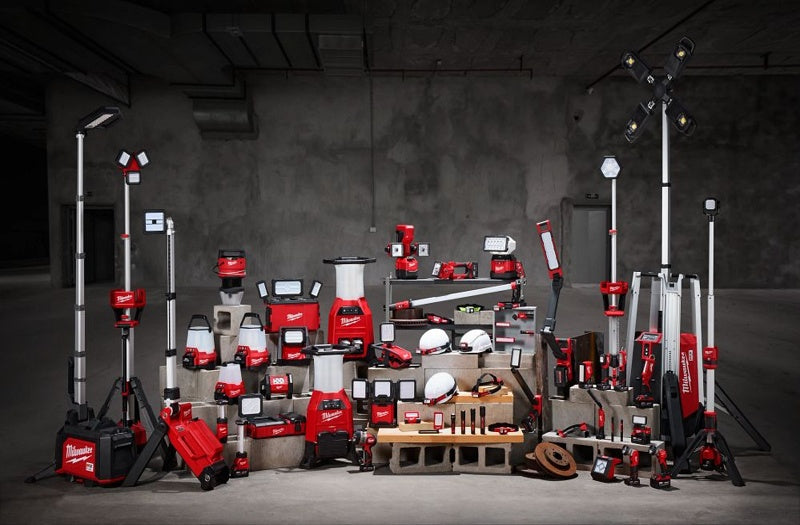
Milwaukee has built one of the most complete job site lighting lineups in the trades. From a compact USB-rechargeable flashlight that fits in your pocket to a 4,500-lumen battery-powered flood light, there's a purpose-built option for nearly every situation a tradesman runs into.
In this guide, we're breaking down every category in Milwaukee's lighting lineup: flashlights, headlamps, flood lights, and site lights, along with how to choose the right light for your trade, your platform, and your job.
More Than Just a Flashlight: How Milwaukee Organizes Its Lighting Lineup

Milwaukee organizes its lighting into a few distinct categories, each built for a different type of use. Understanding the categories first makes it easier to pick the right tool for the job.
Personal lighting, flashlights and headlamps, are meant for individual use on targeted tasks. You're using a flashlight when you need to aim light at something specific. You're using a headlamp when you need both hands free.
Area lighting, flood lights, lanterns, and work lights, are designed to light up a larger space. These are the tools you set down and let work while you do.
Job site lighting, site lights and tower lights are high-output illumination for whole areas, scaffolding setups, or interior work in large unlit spaces.
All three categories run on Milwaukee's M18 battery platform, with several personal lighting options also available as USB-rechargeable models that don't need a battery pack at all.
Milwaukee Flashlights: Built for the Job, Not the Junk Drawer

A job site flashlight needs to be more than bright. It needs to hold up, hold a charge, and be easy to operate with one hand. Milwaukee's flashlights use REDLITHIUM USB technology, meaning they charge via USB and don't require an M18 battery pack.
The 2160-21 is the core of Milwaukee's flashlight lineup. It puts out 800 lumens with multiple output modes, charges via USB, and includes a magnetic base that sticks to metal surfaces to free up your hands. It's compact enough to fit in a shirt pocket but bright enough to actually do work by.
Here's what matters with Milwaukee flashlights: they're not just for finding things in the dark. The high-output modes are genuinely useful for inspecting tight spaces, checking wiring inside panels, and reading measurements in low-light conditions.
|
Model |
Output |
Power Source |
Key Features |
|
2160-21 |
Up to 800 lumens |
USB Rechargeable |
Magnetic base, multiple output modes, pocket-sized |
Milwaukee Headlamps: Hands-Free Light for Every Trade

If you work in tight spaces, inside panels, in crawl spaces, under a vehicle, on a roof, a headlamp is more useful than a flashlight most of the time. Your hands are free to work. The light goes where your eyes go. That's a real productivity advantage.
Milwaukee makes several headlamp options, and the differences matter depending on how you wear it and what you're wearing it on.
The 2163-21 is Milwaukee's hard hat headlamp variant, designed to mount directly onto a Milwaukee REDLINK hard hat or BOLT helmet. It puts out 600 lumens with five output modes, including a red light mode for preserving night vision. It's IP54 rated for dust and water resistance and survives drops from up to two meters.
The 2118-21 BOLT Headlamp is a dedicated BOLT helmet-mount model with 600 lumens and a 70-degree pivoting head, so you can angle the beam without moving your head. It uses USB recharging with no M18 battery required.
The 2012R is a different kind of headlamp; it features a detachable design that functions as either a headlamp or a standalone task light. The magnetic base sticks to metal surfaces, which makes it versatile enough for under-hood work or confined space inspections. It puts out 450 lumens with both spot and flood beam modes.
The 2116-21 BEACON is a hard hat-mounted light designed for 360-degree visibility, a safety feature for workers in environments with vehicle traffic or moving equipment. It's more about being seen than seeing.
|
Model |
Output |
Mount Type |
Power Source |
Key Features |
|
2163-21 |
600 lumens |
Hard hat / helmet |
USB Rechargeable |
5 modes, red light mode, IP54, 2m drop-rated |
|
2118-21 |
600 lumens |
BOLT helmet |
USB Rechargeable |
70° pivot, 4 modes |
|
2012R |
450 lumens |
Head strap / magnetic |
USB Rechargeable |
Detachable task light, spot + flood modes, magnetic base |
|
2116-21 |
360° beacon |
Hard hat |
USB Rechargeable |
High-visibility beacon for safety in traffic/equipment areas |
Milwaukee Flood Lights: When You Need Light for a Space, Not Just a Task

Flood lights are area lights. They're designed to throw light across a broad zone, under a vehicle, inside a panel enclosure, in a trench, or across a work surface. You set them down, aim them, and let them run.
Milwaukee's ROVER series covers most of what you'd want in a flood light for trade work. Here's the breakdown.
The 2359-20 ROVER Compact Folding Flood Light is the most portable option in the lineup. It puts out 1,000 lumens with TRUEVIEW High Definition Output technology, folds flat for transport, and runs 12 hours on high with an M18 XC5.0 battery. It also includes a USB charging port, so it can top off a phone or other device while it's running.
The 2365-20 ROVER Mounting Flood Light puts out 1,500 lumens with both magnetic and clamp mounting options. Up to 20 hours of runtime on high. This is a flexible tool for mechanics and electricians who need a hands-free light they can aim precisely without setting it on a flat surface.
The 2363-20 LED Lantern/Flood Light is a 360-degree option, 700-plus lumens in all directions. Useful for confined spaces, inside enclosures, or any situation where you need ambient light rather than directional light.
At the top end of the ROVER lineup is the 2368-20 ROVER Dual Power Triple-Panel Flood and Area Light. This one puts out 4,500 lumens across three panels that can be angled independently. It runs off both M18 batteries and AC power, making it one of the most flexible lights on the job site.
|
Model |
Output |
Power Source |
Runtime (High) |
Key Features |
|
2359-20 |
1,000 lumens |
M18 Battery |
Up to 12 hrs (XC5.0) |
Folds flat, USB charging port, TRUEVIEW output |
|
2365-20 |
1,500 lumens |
M18 Battery |
Up to 20 hrs |
Magnetic + clamp mount, directional aim |
|
2363-20 |
700+ lumens |
M18 Battery |
Varies by mode |
360° lantern/flood, great for confined spaces |
|
2368-20 |
4,500 lumens |
M18 Battery or AC |
Varies |
Tri-panel, each panel independently adjustable, dual power |
Milwaukee Site and Tower Lights: Lighting Up the Whole Job

Site lights and tower lights are high-output tools built for job site-wide illumination. These aren't for lighting up a task, they're for lighting up a room, a bay, or an exterior work area.
The 2144-20 RADIUS Compact Site Light is one of the most versatile options in the lineup. It puts out 2,200 lumens in area mode and 1,000 lumens in task mode. It's designed to be set up anywhere, on a flat surface, hung overhead, or mounted to a structure, and it runs up to 18 hours on a single M18 battery.
The 2131-20 ROCKET Dual Power Tower Light extends to 7 feet and puts out 2,500 lumens. Dual power means it runs off either M18 batteries or a standard AC outlet, so it works whether you're on a corded job site or off-grid. It's the go-to option for interior rough-in work, trench operations, or any large unlit space.
The 2122-20 Utility Bucket Light is a focused site light designed to drop into a bucket or hang overhead. 1,200 lumens. Good for utility work, manholes, and confined spaces where you need consistent downward light.
The 2123-21HD Search Light takes a different approach entirely. It's a 1,350-lumen remote-controlled search light with up to 500 feet of beam range. This is the tool for tower climbers, linemen working overhead, and emergency response situations.
|
Model |
Output |
Power Source |
Height / Form Factor |
Key Features |
|
2144-20 |
2,200 lumens (area) / 1,000 lumens (task) |
M18 Battery |
Compact, multi-mount |
Up to 18 hrs runtime, area + task modes |
|
2131-20 |
2,500 lumens |
M18 Battery or AC |
Extends to 7 ft |
Dual power, ideal for interior job site lighting |
|
2122-20 |
1,200 lumens |
M18 Battery |
Bucket / hang mount |
Designed for confined spaces, manholes, utility work |
|
2123-21HD |
1,350 lumens |
M18 Battery |
Handheld / tripod mount |
Remote control, 500-ft beam, for overhead + emergency work |
USB-Rechargeable vs. M12 vs. M18: Which Power Source Do You Need?

Milwaukee lights run on three power sources: USB rechargeable, M12 battery, and M18 battery. Here's how to think about which one makes sense for your situation.
USB-rechargeable models, like most of the flashlights and headlamps, are the most convenient for personal lighting. No battery pack required. Charge them with the same USB-C cable you're probably already carrying. These are the lights you grab for inspections, quick checks, and personal use throughout the day.
M12 battery models offer more output than USB options with the added benefit of swapping into your M12 battery platform. If you're already running Milwaukee M12 tools, adding M12-powered lights means one less type of battery to manage.
M18 battery models are where the serious output lives. The ROVER flood lights, RADIUS site lights, and ROCKET tower lights all run on M18. If you're deep into the M18 ecosystem, drills, impact drivers, saws, the lighting lineup plugs right into the same batteries.
Want to know the best part about the dual-power models like the 2131-20 and 2368-20? They run off both M18 batteries and AC power. You're not locked into batteries. If you're on a corded job site, you plug them in. Off-grid, you run the battery.
Which Milwaukee Light Is Right for Your Trade?

Every trade has different lighting needs. Here's a quick breakdown to match the right Milwaukee light to the right work.
Electricians spend a lot of time in unlit spaces, attics, crawl spaces, inside panels. A headlamp with good output and a hands-free mount is non-negotiable. The 2163-21 hard hat headlamp and the 2012R detachable headlamp/task light are both strong options. For working inside a panel, the 2365-20 ROVER Mounting Flood Light with its magnetic mount is hard to beat.
Mechanics working under vehicles need a light that stays put, doesn't blind them when they look up, and puts out enough lumens to actually see what they're doing. The 2012R magnetic task light handles the under-hood work. The 2359-20 folding flood light works well in a bay or under a lift.
Contractors doing interior rough-in or finish work in unlit buildings need real job site lighting. The 2131-20 ROCKET tower light at 7 feet is the go-to for large interior spaces. For smaller rooms or closets, the 2144-20 RADIUS compact site light covers the space without the tower.
Linemen and utility workers doing overhead or remote work need the 2123-21HD search light. The 500-foot beam range and remote control make it the right tool for tower work and emergency situations where you can't be right next to the light source.
The bottom line: Milwaukee's lighting lineup has a purpose-built tool for almost every situation a tradesman runs into. The right starting point is figuring out whether you need personal lighting, area lighting, or full job site illumination, and then picking the model that fits your battery platform.
Browse the full Milwaukee lighting collection at RedToolStore.com to see current availability and kit options across all categories.
Frequently Asked Questions
What is the difference between a Milwaukee ROVER and RADIUS light?
ROVER is Milwaukee's flood light series, portable, area-illuminating lights designed to be set down or mounted for broad coverage. RADIUS is Milwaukee's site light series, which puts out higher lumen counts and is designed for larger-scale job site illumination. ROVER lights tend to be more compact and portable; RADIUS lights are designed to light up entire rooms or work areas.
Do Milwaukee headlamps work with any hard hat, or only Milwaukee hard hats?
The 2163-21 and 2116-21 BEACON are designed to mount to Milwaukee-compatible hard hats and helmets, including the Milwaukee BOLT system. The 2012R uses a standard head strap and works independently of any hard hat. If you're using a non-Milwaukee hard hat, the 2012R is the most universally compatible option.
How long does the Milwaukee 2131-20 ROCKET Tower Light run on a battery?
Runtime on the 2131-20 varies depending on battery size and output mode. Milwaukee's dual-power design also lets you plug it into an AC outlet when you have access to shore power, which removes the runtime concern entirely on corded job sites.
Can the Milwaukee 2359-20 ROVER Compact Flood Light charge my phone?
The 2359-20 includes a built-in USB charging port that allows you to charge devices while the light is running. It's a useful feature for long jobs where you need the light running for hours and want to keep other devices topped off.
What is TRUEVIEW High Definition Output on Milwaukee lights?
TRUEVIEW is Milwaukee's high color-rendering LED technology. Standard LED lights can make colors look washed out or unnatural, which makes it harder to distinguish wires, read markings, or spot defects in materials. TRUEVIEW output renders colors more accurately, which is useful for any trade work that requires color differentiation.
Are Milwaukee USB-rechargeable lights compatible with M18 batteries?
No. USB-rechargeable Milwaukee lights, like the 2160-21 flashlight and 2163-21 headlamp, have built-in REDLITHIUM USB batteries that charge via USB cable. They don't use or accept M18 battery packs. M12 and M18 lights are separate products in the lineup.
What Milwaukee light is best for working in confined spaces like manholes or trenches?
The 2122-20 Utility Bucket Light is designed specifically for this application. It drops into a standard bucket or can be hung overhead to direct light downward into a confined space. The 2363-20 LED Lantern also works well in confined spaces because its 360-degree output fills the whole area with light rather than creating a directional beam.