


Table of contents
Electrical work covers a lot of ground. One day you're roughing in a commercial build, the next you're terminating conductors on a utility job or doing service work in a crawl space, and the tools that work for one project might not always work for another, which is why having all of the options available for each situation matters the most.
Milwaukee's electrician lineup runs from compact M12 tools built for tight spaces and low-amperage work all the way up to heavy-duty M18 FORCE LOGIC equipment designed for large conductor terminations and utility installs. This breakdown organizes those tools by category so you can find what's relevant to the work you're actually doing.
Milwaukee Cable Cutters

Cutting large conductors by hand is a workout, and it slows you down on a big run. Milwaukee's cable cutters use hydraulic FORCE LOGIC technology to cut through copper and aluminum cable cleanly without the need for a manual pump or ratchet.
These tools are built for commercial and industrial electrical work where you're dealing with larger conductors. They're also used extensively in utility and lineman applications, where cable sizes often exceed what a standard hand cutter can handle.
Model |
Description |
M12 600 MCM Cable Cutter Kit |
|
M18 FORCE LOGIC Cable Cutter w/ 750 MCM Cu Jaws |
|
M18 Force Logic Cable Cutter Kit w/ 477 ACSR Jaws |
|
M18 FORCE LOGIC 5" Underground Cable Cutter w/ Wireless Remote |
The M12 600 MCM Cable Cutter Kit (2472-21XC) runs on the M12 battery platform, which makes it lighter and easier to handle in tight spaces. It's a solid choice for smaller cable sizes and applications where you don't have room to swing a larger tool.
The M18 FORCE LOGIC Cable Cutter (2672-20) steps up the capacity with 750 MCM copper jaw capability. That covers most commercial and industrial feeder work you'll run into. The FORCE LOGIC system delivers consistent hydraulic cutting force so you're not relying on hand strength to finish the cut.
If you do overhead distribution or any work involving ACSR conductors, the 2672-21S is the tool to look at. Aluminum Conductor Steel Reinforced cable is one of the tougher materials to cut cleanly, and this kit includes jaws designed specifically for 477 ACSR conductor. Using the right jaw keeps the cut square and protects the conductor ends.
The 2875R-21 is a specialty tool. It's a 5-inch underground cable cutter with a wireless remote that lets you cut without standing directly over the tool. That's designed for vault work and underground utility applications where proximity to the cut point isn't always practical or safe.
Milwaukee Cable Strippers

Stripping large cable by hand is one of those tasks that sounds simple until you're doing it all day. A good cable stripper speeds things up and reduces the risk of nicking the conductor, which matters a lot when you're terminating large copper or aluminum feeder.
Milwaukee makes cable strippers on both the M12 and M18 platforms, and they're available in versions matched to different conductor types. Matching the right stripper to your conductor is important because copper and aluminum have different hardness levels and jacket geometries.
Model |
Description |
M18 Cable Stripper, Bare Tool |
|
M18 Cable Stripper Kit w/ 17 Cu THHN / XHHW Bushings |
|
M18 Cable Stripper Kit for Al THHN / XHHW |
|
M18 Cable Stripper Kit for Cu RHW / RHH / USE |
|
M18 FUEL Covered Conductor Cable Stripper |
|
M12 Cable Stripper, Bare Tool |
|
M12 Cable Stripper Kit for Al THHN / XHHW |
The M18 Cable Stripper (2935-20) is the base tool in the lineup. It's designed for copper THHN and XHHW, which are two of the most common wire types you'll pull through conduit on a commercial or industrial job. If you've already got M18 batteries and a charger, the bare tool is the lower-cost entry point.
The 2935CU-21S kit includes 17 copper THHN/XHHW bushings, giving you wide coverage across conductor sizes without having to source them separately. That's a good value if you're doing a range of feeder sizes on the same job.
For aluminum conductors, the 2935AL-21 and 2435AL-21 are purpose-built for Al THHN/XHHW. Aluminum is softer than copper, so the geometry and stripping action needs to be matched to the material. Using a copper bushing on aluminum tends to score the conductor and creates a weak point at the lug termination.
The 2935X-21 is set up for Cu RHW, RHH, and USE conductors. These are thicker-jacketed cable types used in wet locations and underground applications where you need a conductor rated for direct exposure to moisture. They need a different stripping setup than standard THHN because the jacket is heavier.
The 2937-20 M18 FUEL Covered Conductor Cable Stripper is a specialty tool, built for covered overhead distribution conductors. Covered conductor is different from fully insulated cable, and this is not a tool you'd use on a typical panel or branch circuit install. It's built for lineman and utility work on overhead systems.
The M12 platform options, the 2435-20 and 2435AL-21, bring the same functionality to a more compact tool. If you're working in tighter spaces or prefer a lighter tool, the M12 stripper is worth looking at.
Milwaukee Crimpers

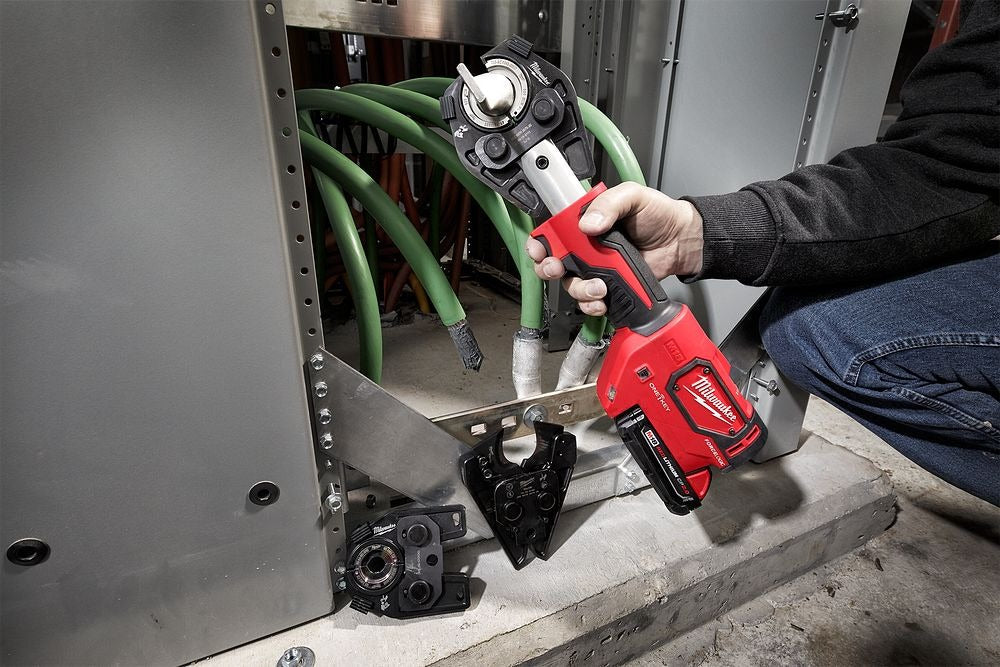
Milwaukee's crimper lineup is one of the most detailed in the electrician tool space. They make pistol crimpers, linear crimpers, latched linear crimpers, and dieless crimpers, all built on the M18 FORCE LOGIC hydraulic platform. The wide selection exists because utility and industrial termination work has a lot of variables, and the right tool depends on your connector type, conductor size, and the space you're working in.
Before you pick a crimper, here are the key specs to understand:
- Die groove type: D3, Kearney, BG (Burndy-compatible), and O-die are the common formats. Your connector determines which groove you need.
- Force rating: Milwaukee makes 6T, 11T, and 12T crimpers. More tonnage means you can handle larger conductors and still get a complete crimp.
- Pistol vs. linear: Pistol-style crimpers have a perpendicular jaw configuration. Linear crimpers keep everything in line with the barrel of the tool, which helps in tight spots.
- Latched vs. standard: Latched crimpers hold the cycle until it's fully complete, which ensures a full crimp before the tool releases.
- Dieless: No dies to swap. The tool crimps across a range of sizes without a separate die. Faster to set up but not available for all connector types.
6T Utility Crimpers

Model |
Description |
M18 FORCE LOGIC 6T Utility Crimper, Bare Tool |
|
M18 Force Logic 6T Utility Crimping Kit w/ D3 Grooves "Snub Nose" |
|
M18 Force Logic 6T Utility Crimping Kit w/ D3 Grooves & Fixed BG Die |
|
M18 Force Logic 6T Utility Crimping Kit w/ Kearney Grooves |
|
M18 Force Logic 6T Pistol Utility Crimper w/ BG-D3 Jaw |
6T Linear Utility Crimpers

Model |
Description |
M18 FORCE LOGIC 6T Linear Utility Crimper w/ Snub Nose Jaw |
|
M18 FORCE LOGIC 6T Linear Utility Crimper w/ O-D3 Jaw |
|
M18 FORCE LOGIC 6T Linear Utility Crimper w/ BG-D3 Jaw |
|
M18 FORCE LOGIC 6T Linear Utility Crimper w/ Kearney Jaw |
|
M18 FORCE LOGIC 6T Linear Utility Crimper Kit w/ Snub Nose Jaw |
|
M18 FORCE LOGIC 6T Linear Utility Crimper Kit w/ O-D3 Jaw |
|
M18 FORCE LOGIC 6T Linear Utility Crimper Kit w/ Kearney Jaw |
|
M18 FORCE LOGIC 6T Linear Utility Crimper w/ O-D3 Jaw & Cutting Jaws |
|
M18 FORCE LOGIC 6T Linear Utility Crimper w/ BG-D3 Jaw & Cutting Jaws |
|
M18 FORCE LOGIC 6T Latched Linear Utility Crimper, Tool Only |
|
M18 FORCE LOGIC 6T Latched Linear Utility Crimper (Kit) |
600 MCM and 750 MCM Crimpers

Model |
Description |
M18 FORCE LOGIC 600 MCM Crimper, Tool Only w/ Case |
|
M18 FORCE LOGIC 600 MCM Crimper Kit |
|
M18 FORCE LOGIC 600 MCM Crimper w/ #8-600 MCM Cu Dies |
|
M18 FORCE LOGIC 600 MCM Cu Crimper w/ 750 MCM Expanded Jaw & Dies |
|
M18 FORCE LOGIC 600 MCM Crimper w/ #8-350 MCM Aluminum Dies |
|
M18 FORCE LOGIC 600 MCM Aluminum Crimper w/ 750 MCM Expanded Jaw Kit |
|
2779-20 |
M18 FORCE LOGIC 750 MCM Crimper, Tool Only |
M18 FORCELOGIC 750 MCM Crimper (Kit) |
|
M18 FORCE LOGIC 750 MCM Crimper w/ #6-750 MCM Aluminum Dies |
|
M18 FORCE LOGIC 750 MCM Dieless Crimper, Bare Tool |
11T and 12T Crimpers

Model |
Description |
M18 FORCELOGIC 12T Utility Crimper (Kit) |
|
M18 FORCE LOGIC 11T Dieless Latched Linear Utility Crimper, Tool Only |
|
M18 FORCE LOGIC 11T Dieless Latched Linear Utility Crimper (Kit) |
|
M18 FORCE LOGIC 12T Kearney Linear Crimper, Tool Only |
|
M18 FORCE LOGIC 12T Kearney Linear Crimper Kit |
|
M18 FORCE LOGIC 12T Latched Linear Crimper (Kit) |
The 6T crimpers are the most common choice for distribution and substation termination work. The pistol-style tools like the 2977-22BG give you a more familiar grip configuration, while the linear tools in the 2978 series work better when you're reaching into a confined area and need to keep the tool parallel to the conductor.
The OCUT and BGCUT models add a cutting jaw to the linear crimper, which means you can cut and crimp with the same tool. That's useful when you're working on both ends of a conductor run and don't want to switch tools.
The 600 MCM and 750 MCM crimpers handle the heavier conductor ranges. If you're doing large service entrances, transformer terminations, or utility interconnects, these are the tools that cover those conductor sizes. The aluminum die sets in the 2679-350AL and 2679-750AL are specific to aluminum conductors, which require different crimping geometry than copper.
The 11T and 12T tools step up both the force and the conductor range. The 2876 series dieless crimpers are fast to set up because there are no dies to swap, but the latched mechanism ensures the cycle completes fully. The 12T Kearney crimpers in the 2878K series are built for Kearney-style connectors, which are standard in many utility applications.
Milwaukee Fish Tape

Fish tape is one of those tools that doesn't get much attention until you're in a wall or ceiling run that's not cooperating. Milwaukee's M18 FUEL Angler is a powered fish tape system that uses the M18 battery platform to drive the tape through conduit, which cuts down on the time and effort compared to pushing tape by hand.
The Angler system separates the powered base from the tape drum, so you can run different tape lengths or materials on the same base. Milwaukee offers steel pulling tape and non-conductive polyester tape, depending on the application.
Model |
Description |
M18 FUEL Angler Pulling Fish Tape Powered Base, Tool Only |
|
M18 FUEL Angler 120' Steel Pulling Fish Tape Kit |
|
M18 FUEL Angler 240' Steel Pulling Fish Tape Kit |
|
M18 FUEL Angler 120' x 1/8" Steel Pulling Fish Tape Drum |
|
48-44-5178 |
M18 FUEL Angler 240' x 1/8" Steel Pulling Fish Tape Drum |
M18 FUEL Angler 100' Non-Conductive Polyester Fish Tape Drum |
The 2873-20 powered base is the core of the system. If you already own the base, you can add different tape drums without buying a whole new kit. That makes it a scalable setup for shops or contractors who do a lot of varied conduit work.
The 2873A-22 and 2873B-22 kits include the powered base plus steel tape drums at 120 feet and 240 feet respectively. Steel tape is the standard choice for most pulling applications because it's rigid enough to push through bends without binding up.
The individual drum accessories (48-44-5176 and 48-44-5178) are sold separately if you need to add tape length to an existing base setup. The 240-foot drum covers longer runs in commercial and industrial conduit systems where you might be fishing across a larger floor plate or through a long straight run.
The 48-44-5195 non-conductive polyester drum is the choice for work near energized equipment. Polyester tape doesn't conduct electricity, which matters when you're fishing in a panel, near live conductors, or in any application where the tape could make contact with an energized part. At 100 feet, it's designed for shorter runs where electrical safety is the priority.
Milwaukee Knockout Tools

Punching holes in enclosures, panels, and sheet metal is part of almost every commercial electrical install. Milwaukee's knockout tool lineup covers hand-ratchet sets for occasional use and M18 FORCE LOGIC hydraulic punches for high-volume production work.
Model |
Description |
Milwaukee EXACT 1/2" to 2" Hand Ratchet Knockout Set |
|
M18 FORCE LOGIC 6T Knockout Tool 1/2" - 2", Bare Tool |
|
2677-04 |
M18 FORCE LOGIC 6T Knockout Tool 1/2" - 4", Bare Tool |
M18 FORCE LOGIC 6T Knockout Tool 1/2" - 2" Kit |
|
M18 FORCE LOGIC 6T Knockout Tool 1/2" - 4" Kit |
|
2676-04 |
M18 FORCE LOGIC 10 Ton Knockout Tool 1/2" to 4" |
The 49-16-2694 hand ratchet knockout set covers 1/2" through 2" trade sizes without a battery or hydraulic pump. It's a good option for occasional knockout work or as a backup when you don't have power available. The set uses a ratchet drive, which is easier on your hands than a standard threaded punch setup.
The M18 FORCE LOGIC Knockout Tools take the manual effort out of the process entirely. The 6-ton tools in the 2677 series handle 1/2" through 2" (2677-02, 2677-21) and 1/2" through 4" (2677-04, 2677-23) depending on the model. The 4-inch range covers every standard conduit trade size you'll need for panel work, including the larger knockouts for 3-1/2" and 4" conduit entries.
The 2676-04 10-ton knockout tool steps up the force rating for applications where the material is thicker or where you need to punch larger sizes more consistently. The extra tonnage reduces cycle time on heavier-gauge enclosures and ensures a clean punch every time.
Kit versions include dies and a carrying case. If you already own the base tool and batteries, the bare tools are the lower-cost option. The die sets are interchangeable within the FORCE LOGIC knockout platform, so you can build out your die collection over time.
Other Milwaukee Electrician Tools

Not every tool fits neatly into a category, but that doesn't make it any less useful on the job. This section covers a handful of Milwaukee tools that show up regularly in electrical work -- from field soldering and threaded rod cutting to job site monitoring. They're not the headliners, but if you've ever needed one of these on a job and didn't have it, you know exactly why they're worth keeping in your kit.
Model |
Description |
M12 Soldering Iron Kit |
|
M18 Brushless Threaded Rod Cutter, Bare Tool |
|
M18 Brushless Threaded Rod Cutter Kit |
|
M18 Wireless Monitor, Bare Tool |
The M12 Soldering Iron (2488-21) is handy for field repairs, control panel work, and any application where you need a quick, portable heat source without a corded iron.
The M18 Brushless Threaded Rod Cutter (2872-20 and 2872-21) is used for cutting all-thread and threaded rod, which comes up frequently on conduit support and strut work. It's cleaner and faster than a hacksaw, and it doesn't leave burrs that can strip nuts.
The M18 Wireless Monitor (2971-20) is a remote monitoring tool that works within the M18 ONE-KEY ecosystem. It's built for job site applications where you need to track environmental conditions or monitor tool activity remotely.
Frequently Asked Questions
What's the difference between RHW, RHH, and USE cable, and why do they need a different stripper?
RHW, RHH, and USE are all conductors designed for wet, damp, or direct-burial applications. They share a cross-linked polyethylene insulation system, but they're rated for different temperature and exposure conditions. RHH is rated for dry locations up to 90°C, RHW covers wet locations up to 75°C, and USE is rated for underground service entrance applications. Their jackets are thicker and tougher than standard THHN, which is why Milwaukee makes a dedicated stripper kit (2935X-21) for these conductor types rather than lumping them in with the standard THHN/XHHW kits.
What trade sizes do Milwaukee's FORCE LOGIC knockout tools cover?
The 6T FORCE LOGIC knockout tools cover 1/2" through 2" on the smaller models and 1/2" through 4" on the larger models. The 10-ton tool also handles 1/2" through 4". Those ranges cover every standard conduit trade size you'd encounter on a typical commercial or industrial panel install, including the larger 3-1/2" and 4" entries needed for bigger service equipment.
What's the ONE-KEY feature and which Milwaukee electrician tools support it?
ONE-KEY is Milwaukee's tool management platform that lets you track, customize, and manage compatible tools through a smartphone app. The M18 Wireless Monitor (2971-20) works within this ecosystem. For most of the FORCE LOGIC tools, the primary value is tool tracking on larger job sites where equipment loss or theft is a concern. Not every tool in the electrician lineup includes ONE-KEY, so check the individual product specs if that's a feature you're looking for.
What is ACSR and why does it need a specific jaw on a cable cutter?
ACSR stands for Aluminum Conductor Steel Reinforced. It's a two-part conductor with aluminum strands wrapped around a steel core, and it's used heavily in overhead distribution and transmission lines. The steel core makes it significantly harder to cut than standard copper or aluminum conductors of the same size. Cutting ACSR with a standard copper jaw risks damaging the jaw and won't always produce a clean cut. Milwaukee makes jaws specifically rated for ACSR, like those included in the 2672-21S kit.
What's the difference between THHN and XHHW cable, and does it affect which stripper I need?
THHN and XHHW are both common building wire types used in conduit, but they have different jacket constructions. THHN has a nylon outer jacket over PVC insulation. XHHW uses cross-linked polyethylene insulation without the nylon layer. Milwaukee's cable strippers are rated for both, and most of the Cu THHN/XHHW kits cover both wire types with the included bushings. Always match the bushing to the conductor size and type you're working with.
What's the difference between a 6T, 11T, and 12T crimper?
The tonnage rating is how much hydraulic force the tool applies during a crimp cycle. A 6T crimper works well for most distribution and substation termination work. The 11T and 12T tools are built for larger conductor sizes and heavier utility applications where a full crimp requires more force to complete properly.